USAID. MISSION TO BOTSWANA
Agricultural technology improvement project (ATIP) : external evaluation
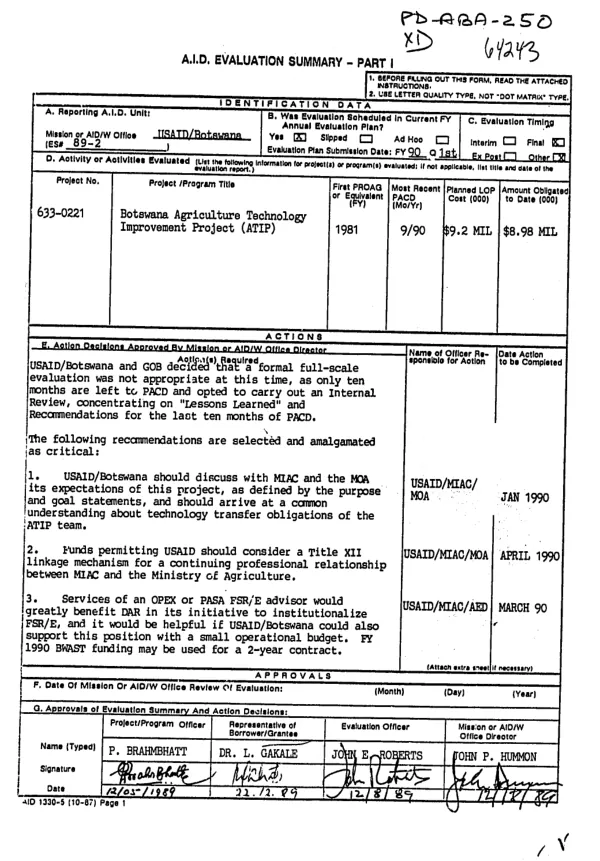
Evaluates project to incorporate farming systems research (FSR) into the programs of Botswana"s Ministry of Agriculture (MOA).
1986
Sign in to readA free account is required to download.
Abstract
External, mid-term evaluation covers the period 7/84-6/86. A broad FSR approach to identifying production constraints and to designing trials to test and demonstrate appropriate technology has been implemented. Two teams of Batswana and expatriate FSR technicians are working in the Mahalapye and Francistown regions and have performed well. Although field work has been complicated by low and unreliable rainfall, a large number of surveys and trials have been completed. The teams should now focus on choosing key variables and defining a replicable FSR methodology. Training has been an important and successful component. B.S. or M.S. training is being provided to 15 Batswana, several of whom have already returned to duties in the project or elsewhere in the MOA. Since programmed A.I.D. training funds having been exhausted, other funds, especially those committed by the Government of Botswana (GOB), should be sought vigorously to train as many research, extension, and planning specialists as possible. USAID/B support has been adequate and some procedures have improved much since the last review. However, reimbursement procedures need to be streamlined and USAID/B should agree to fund participation in professional seminars and workshops. The GOB has generally contributed as agreed (indicating its support of the project), but better housing and other benefits for Batswana FSR staff are critically needed to retain these competent and well-trained people in the project area. While FSR cannot easily be institutionalized at this time, its potential integration into ongoing research and extension programs has been advanced. An important lesson is that national decisionmakers, and regional and district agricultural officers, must have a good understanding of how FSR can enhance the effectiveness of a research and extension system if they are to accept it. The evaluation team concurs with the recent project extension to 9/89 and hopes that the present contractor, Mid-America International Agricultural Consortium, will be able to continue through that period. For USAID/B action decisions, see the abstract of PD-AAU-907. The project has taught the need to: (1) complement on-station with on-farm research in order to increase the currently low level of technology adoption; (2) have contingency plans when developing technology packages for countries with difficult soil/rainfall conditions; (3) inform MOA personnel of the FSR approach and include them in FSR activities; (4) adopt a team approach to research/extension and work with social scientists and commodity research specialists in FSR; and (5) improve research-extension linkages.