USAID. MISSION TO BOTSWANA
Agricultural technology improvement project
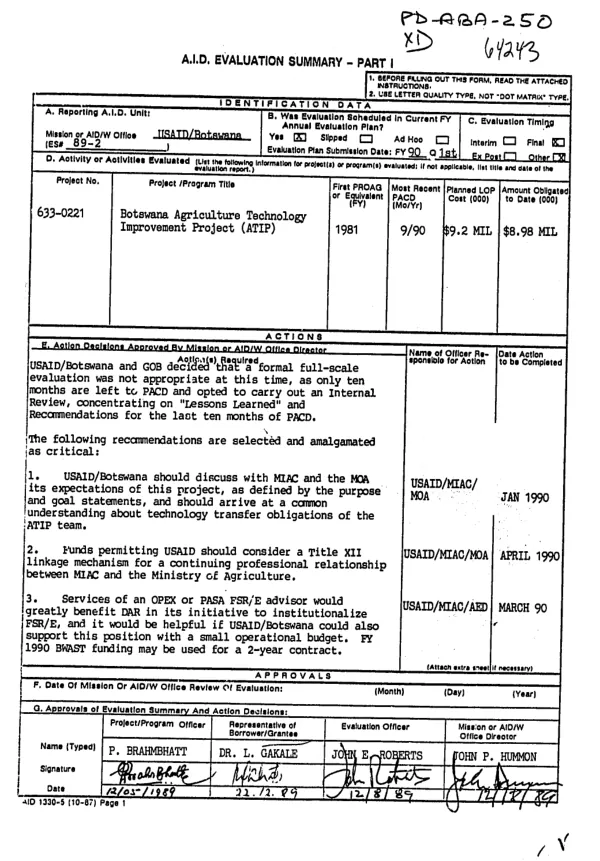
Evaluates project to improve the capacity of the Government of Botswana"s (GOB"s) Ministry of Agriculture (MOA) to develop farming systems research (FSR) and extension programs relevant to the needs of small farmers.
Segwele, Howard; Mackie, Anita · 1984
Sign in to readA free account is required to download.
Abstract
Mid-term PES covers the period 7/82-7/84 and is based on document review, interviews with MOA and other officials, and field visits. The cooperation showed to the PES team by all involved is strongly noted. The Project Paper for this project could well serve as a model for other FSR projects, and project implementation has benefitted from a superb contract team, substantial GOB participation, use of the collaborative assistance mode of contracting, long-term commitments from project personnel, selection of the latter on the basis of expertise and experience in the region, and excellent relations with the Agricultural Development Officer. Although a prolonged drought has made it impossible to meet output targets, the process for achieving them is in place. Two FSR teams have been established, and the project has developed or used an impressive array of agronomic and economic tools and of survey and data collection forms designed to measure the yield effects of the technological innovations which the project is at the brink of determining. In a word, the project is practicing state-of-the art FSR. On the negative side, the location at different sites of the FSR teams, the Chief of Party (COP), and the Research and Extension Liaison Officer (RELO) has caused difficulties in project management. Major action decisions are to: develop a plan to double FSR training, increase allocations for degree training, and appoint a Botswana as counterpart to the COP in order to institutionalize the project within the MOA; consider integrating FSR into the Botswana Agricultural College"s curriculum for extension demonstrators; increase communication between central station and village-level researchers; and initiate seed production activities to solve the current seed crisis and to provide a long-term potential for supplying quality seed. Finally, a project extension should be considered soon, especially since most practitioners agree that FSR projects show results only over a 10-20 year span.
Related documents