USAID. MISSION TO BOTSWANA
Botswana agriculture technology improvement project (ATIP)
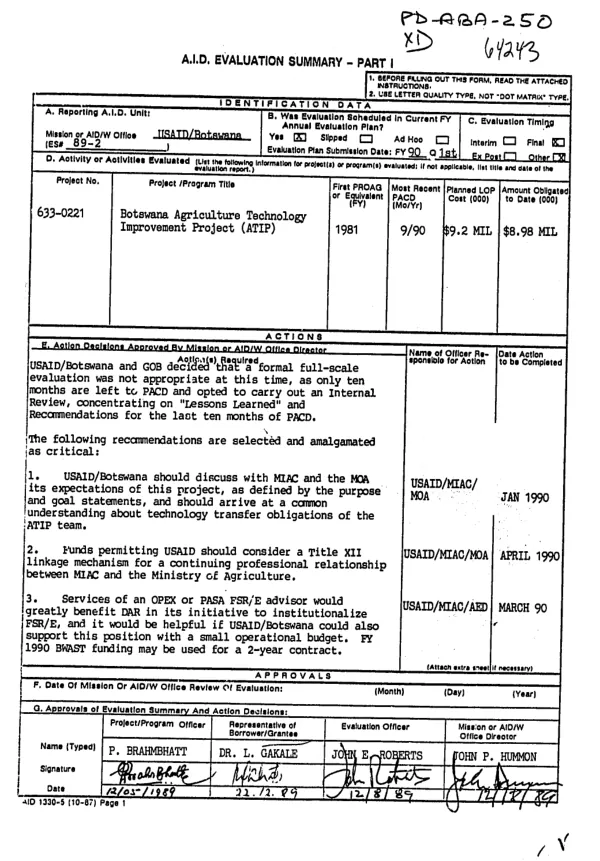
Summarizes internal evaluation (XD-ABA-250-A) of a project to institutionalize in Botswana"s Ministry of Agriculture (MOA) a farming systems research and extension (FSR/E) methodology applicable to the needs of small farmers.
1989
Sign in to readA free account is required to download.
Abstract
Internal evaluation covered the period 1981-11/89. Although persistent drought has hampered project impact on production and farmer incomes, much progress has been made in the implementation of FSR/E and in institutionalizing the methodology within the MOA. Project staff are working in the field in Francistown and Mahalapye, the national FSR/E office is operating at the Sebele field station, and a national research and extension coordination unit has been established. The project has personnel stationed in both of these key national units. Recently, the project also generated information for use by the MOA"s Division of Planning and Statistics and the Ministry of Finance and Development Planning. The following areas require increased attention. (1) The role of the Research and Extension Liaison Officer needs to be better defined and integrated into the FSR/E technology development and transfer process. (2) The issue of how to incorporate livestock in FSR/E activities needs to be resolved. (3) Although training in most regards has been highly successful, the project has not taken full advantage of its short-term training funds to send MOA diploma or certificate holders to participate in crop management training courses at international agricultural research centers. The placement of project-trained degree students in field teams and the utilization of short-term training funds should be improved. Several lessons were learned. (1) To assure sustainability, a project should be small enough to operate within an existing organization. In the present case, the MOA"s Department of Agricultural Research may lack adequate resources to continue supporting all project activcities after the PACD. (2) Restructuring an organization like the MOA and institutionalizing a process like FSR may require policy changes at the highest levels. (3) An FSR/E project should consider agroclimatic conditions when determining project duration. Under marginal production conditions, an 8-10 year project is more realistic. (4) On-station research may be a prerequisite to successful FSR/E work where proven off-shelf technologies are not readily available. (5) The lack of housing for project staff has affected morale and diminished work efficiency.