USAID. MISSION TO INDONESIA
Agriculture and rural sector support program (ARSSP)
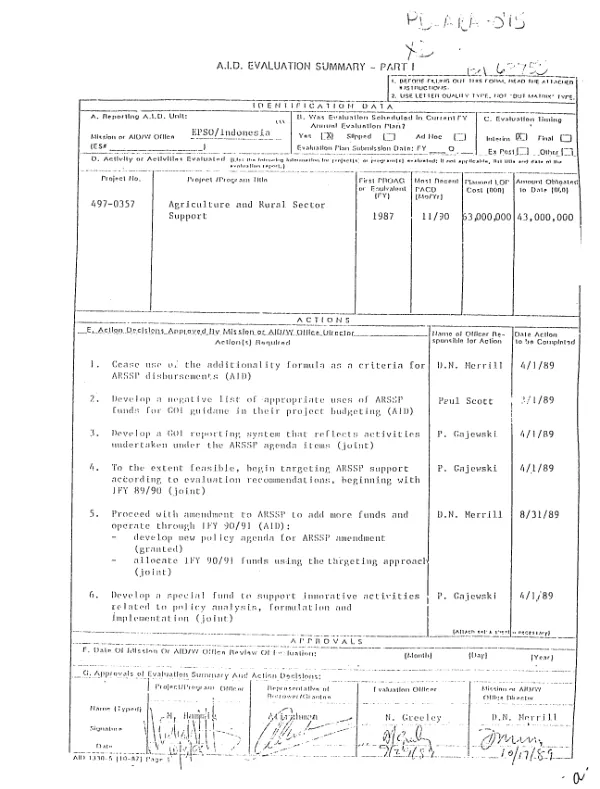
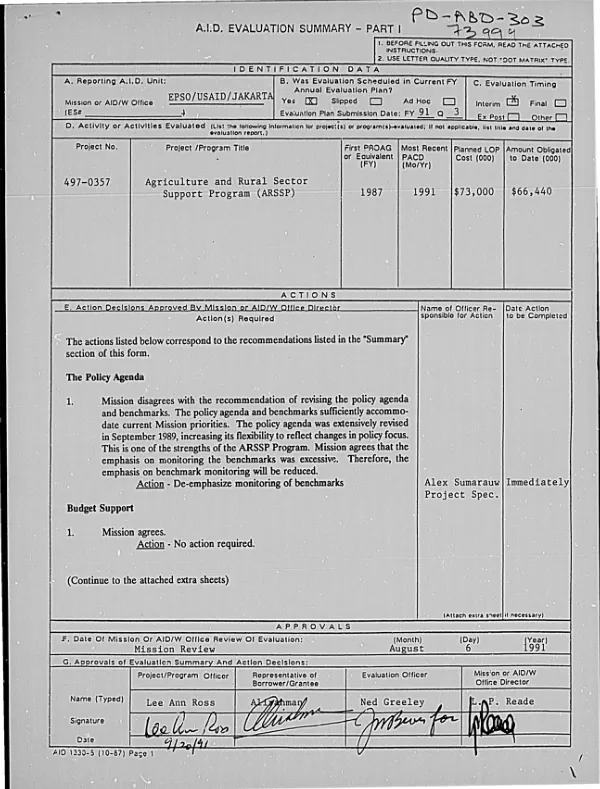
Summarizes interim evaluation (XD-ABD-303-A) of a program to support economic policy reform in Indonesia through (1) policy dialogue, (2) budget support to Government of Indonesia (GOI) agricultural and rural-oriented entities during a period of fiscal crisis, and (3) related TA.
1991
Sign in to readA free account is required to download.
Abstract
The evaluation covered the period 2/89-7/91. Overall, the program has been an important part of U.S. assistance to Indonesia and is highly regarded there. The performance of the individual program components has varied, however. The policy agenda component was something of a misnomer in that all the important reforms were decided on by the GOI before or outside of the program. has been important in helping with ideas, and policy implementation has been a major strength of the program. Though well-intentioned and innovative, the budget support element probably changed little in terms of GOI policies or programs. Its effectiveness was vitiated by prolonged delays in funding; by the time funding issues were resolved, the fiscal crisis had abated. However, the promise of funds was alone enough to secure continuation of some programs for a time. This element will be phased out and the limited funds remaining will be allocated to the Integrated Pest Management (IPM) project. TA, the smallest of the three components, proved the most effective and is generally regarded as responsive and helpful. TA will be the primary emphasis during the remainder of the program; the name of the program may be changed to reflect this emphasis. Neither BAPPENAS nor USAID has the management capacity to monitor the totality of the program effectively, although individual ministries are able to do so for their respective subprojects, and USAID/I internal management is programmatically effective, if highly personal. The Mission rejected evaluation recommendations to revise the policy agenda and to disengage the TA agenda from the policy agenda. It did, however, agree that the policy monitoring requirements have been excessive. Several lessons were learned. (1) Donors should be wary of attributing national policy shifts to external advice unless a causal relationship can be established; even a major financial commitment will not itself induce policy changes if the recipient has not already determined that such changes are in its interest. (2) Short-term TA is often an effective way to support policy objectives, although external TA in general is subject to local concepts of power and information. (3) Missions need the flexibility to respond quickly to local needs. (4) If A.I.D makes a commitment to respond to a crisis in a recipient"s economy, the administrative means to do so should take priority. (5) A.I.D and donors in general need to understand the place of programs/projects in the overall political economy of the state.