USAID. MISSION TO INDONESIA
Agriculture and rural sector support
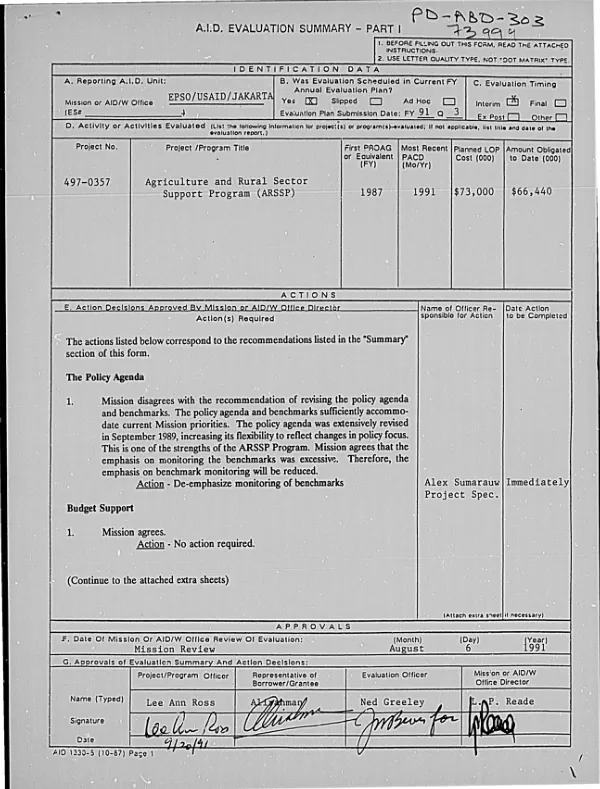
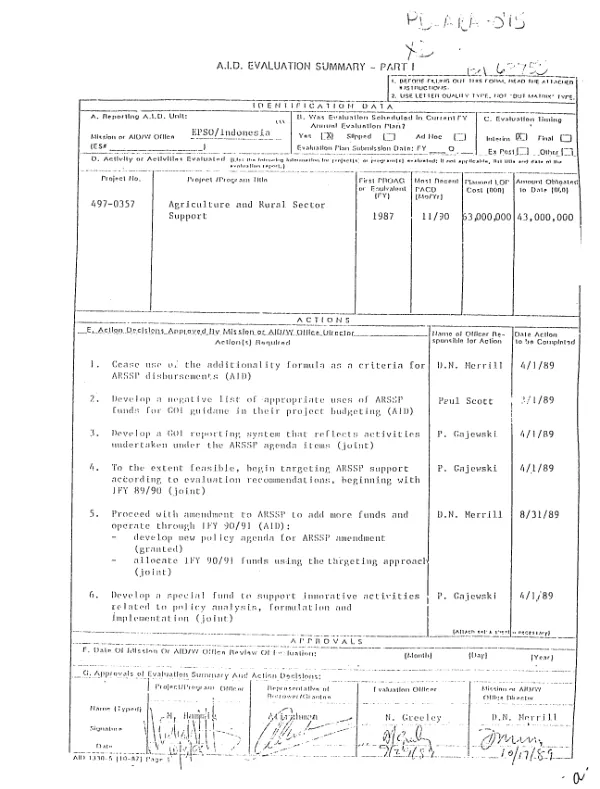
Summarizes midterm evaluation (XD-ABA-075-A) of a program to provide budget support to key Government of Indonesia (GOI) ministries engaged in the agriculture and rural sector policy reform process.
1989
Sign in to readA free account is required to download.
Abstract
The evaluation covered the period FY87-2/89. Although the program was purposely designed without conditionality, overall progress in policy reform has been far greater than expected. Particularly noteworthy are the successes in pesticide and fertilizer subsidy reductions, inter-island transport deregulation, and banking reform. It is impossible to prove a causal relationship between A.I.D. assistance and policy reform, but the program has contributed to the reform process by: (1) providing resources to support policy research, analysis, and review, which reportedly generated reform proposals and helped broaden the consensus for policy change; (2) financing study tours to provide exposure to alternative policy regimes; (3) providing support for the start-up of an integrated pest management program; (4) financing technical research to support adjustments in agricultural input pricing policy; and (5) filling a niche in donor program assistance by focusing attention on agricultural incentive issues. On the negative side, disbursement of program funds was uneven and unduly hampered by cumbersome requirements to ensure additionality of funds to the GOI budget. In some cases the uneven flow of funds caused serious disruption in GOI agency operations. The program was understaffed until recently due to the false assumption that program assistance requires relatively less staff per dollar than project assistance. While the program was originally planned to provide short-term "bridging" support to the GOI"s development budget, USAID/I discovered during implementation that it is possible to use a portion of the budget support funds to support the implementation of policy changes decided upon by the GOI. In the view of the evaluation team, such "targeted budget support" is the best and highest use of budget support and should constitute the bulk, if not all, of A.I.D.-provided program assistance. Several other lessons were also learned. (1) Generic budget support is not possible in Indonesia becuase GOI accounting procedures require that foreign donor funds be traceable to their ultimate expenditure. (2) Focusing on additionality criteria needlessly diverts attention from the more fundamental questions of policy reform. (3) Program assistance raises policy dialogue to a level not generally observed. (4) General budget support, even when focused on selected agencies, cannot be expected to be allocated most advantageously without some degree of Mission collaboration on allocation decisions. Action decisions are, inter alia, to cease the use of additionality criteria for disbursements and to extend the program through Indonesian FY91.
Related documents