USAID. BUR. FOR LATIN AMERICA AND THE CARIBBEAN. REGIONAL DEVELOPMENT OFC.
Agriculture research and extension
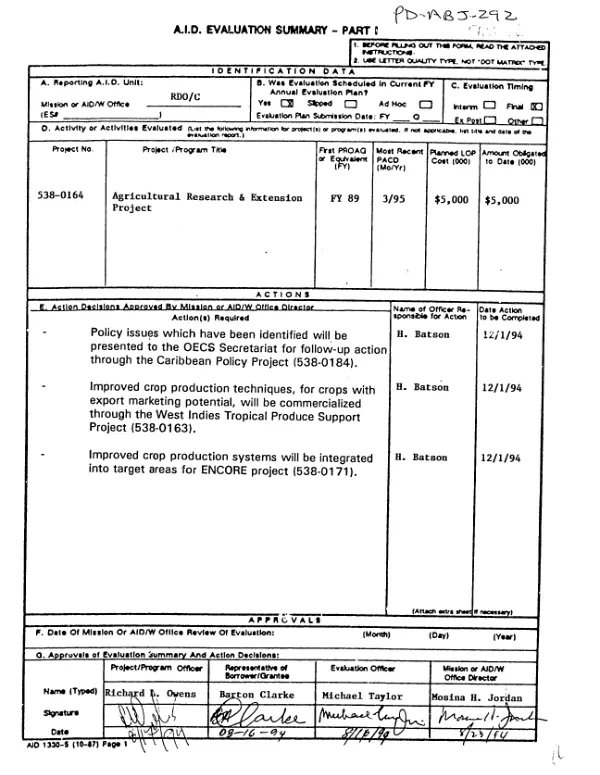
Summarizes attached evaluation (XD-ABE-304-A) of a project to strengthen the institutional capabilities of national and regional agricultural research and extension organizations in the Eastern Caribbean.
1992
Sign in to readA free account is required to download.
Abstract
Midterm evaluation covers the period 3/89- 9/91. The Caribbean Agricultural Research and Development Institute (CARDI) is the main implementing agency. The project is making good overall progress, particularly in the area of strengthened research and extension linkages. A promising model is emerging which utilizes a crop-specific task force involving researchers, extensionists, farmers, and end users in an integrated, market-driven process for supplying users with goods, especially perishable fruits and vegetables; the model was most advanced in Nevis and St. Vincent. Also, project-funded training -- especially the diploma program at the University of the West Indies -- has had a positive impact on the performance of research and extension personnel, and the National Agricultural Extension Services (NAE"s) have been strengthened considerably under this project and its predecessors. Several areas require corrective action, however. (1) The research prioritization process is too subjective and should be revised to emphasize quantitative considerations, particularly market conditions and potential, and employment and income generation considerations. Too many agricultural commodities have been accorded priority status, spreading resources too thin and diluting project impact. (2) Newly hired front line extension officers often lack the technical and analytical skills needed to deal successfully with farmers growing high value non-traditional export type crops. (3) While farmer involvement in research and extension planning and implementation at the local level is significant, the systematic involvement of private sector groups such as farmers" organizations, and associations of processors and exporters, in national or regional level planning and priority setting has been limited. (4) The communications support program is the least advanced element of the project. Linkages between NAE"s and the Regional Communications Unit are weak, hindering the achievement of project objectives, and there is a critical need for more farmer- friendly printed materials to reinforce the technologies disseminated through on-farm demonstrations and formal training. Only a small number of farmers are using the farm/home management records program book. (5) Linkages with the international agricultural research community have been sporadic. (6) There are few reliable data sets for estimating technology adoption rates, the extent and causes of yield changes, or the relation between technology adoption and changes in agricultural employment and income. Lessons learned include the following. (1) The technology generation and transfer process with regard to non-traditional fruits and vegetables needs to be market-driven or else has little chance for success. (2) A quantitative approach to research prioritization and impact measurement is essential. (3) Significant, and in many cases untapped, markets for non-traditional fruits and vegetables exist within many of the Eastern Caribbean countries.