USAID. MISSION TO SENEGAL
Natural resources based agricultural research (NRBAR)
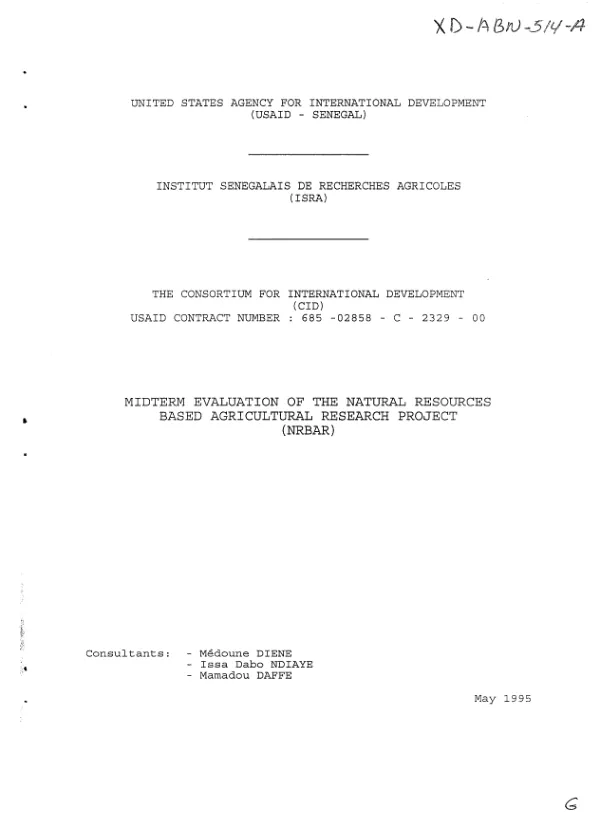
Summarizes mid-term evaluation (XD-ABN-514-A) of a project to support the Institut Senegalais de Recherches Agricoles (ISRA) in designing low-cost natural resources-based technologies to increase the productivity and sustainability of cropping systems for millet, sorghum, corn, and rice.
1996
Sign in to readA free account is required to download.
Abstract
The project is being implemented by the Consortium for International Development (CID) and ISRA. The evaluation covers the period 1991-2/95 against a PACD of 7/98. By improving the quality of the Institute"s research and planning organization, the project has undoubtedly helped to institutionalize practices that have improved the scientific and technical performance of ISRA programs. The project has also contributed significantly to the design of ISRA"s Natural Resources Management (NRM) program, enabling the design of a coherent research strategy for NRM-based technologies. Ernst and Young has made progress in improving ISRA"s financial management system, despite the lack of monitoring and of supervision by ISRA, which was a major constraint until the establishment of the Pilot Committee. A large number of ISRA researchers experienced difficulties in establishing good interpersonal relationships with the technical advisors during the development phase of the project due to the fact that the project was not considered an integral part of ISRA. Advisors should be integrated into ISRA structure and should share offices with their counterparts. In addition, ISRA authorities should create the conditions for the gradual integration of the several management tools developed under the project. Mechanisms are needed for integrating the researchers receiving long-term training into the different research programs. Lessons learned are as follows. (1) There should be as few ambiguities as possible between the versions of a project document in order to avoid varying interpretations of its main elements. (2) It is not always easy to implement an institutional support project that calls into question certain rigid work behaviors. It takes time for such a project to achieve its objectives. (3) The effectiveness of a project always depends on the actual ability of the beneficiary to identify itself with and adhere to the project. If there is no such ability, this shortcoming should be corrected before the project is initiated. (4) Project grants with overly restrictive conditions precedent often hurt the working climate and may in the long run jeopardize the accomplishment of project objectives. (5) An institution which is a beneficiary of a project should be committed to its implementation and assume responsibility for it. For this to happen, the institution should be fully empowered and not merely be associated in the making of decisions. (6) To be efficient, advisors have to harmonize their methodological approach and to get along with customers.