USAID. MISSION TO NIGER
Agriculture sector development grant
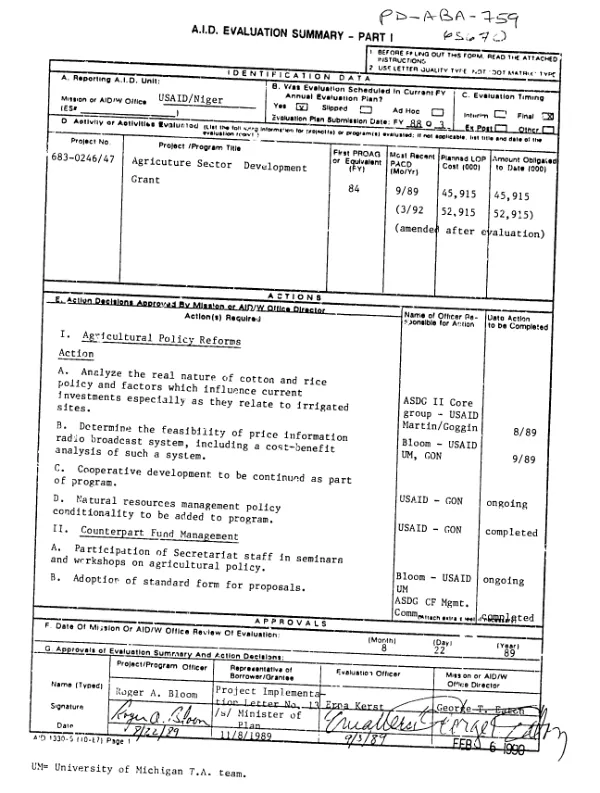
Summarizes final evaluation (XD-ABA-759-A) of a program to provide grant assistance and TA in return for agricultural policy reforms in Niger.
1990
Sign in to readA free account is required to download.
Abstract
The evaluation covered the period FY84-3/89. The program was on balance very successful. All the specified policy reforms were carried out except for the broadcasting of price information, which remains on the reform agenda. However, the impact of the reforms has been limited by lack of a true cooperative movement in Niger. While a few cooperatives are gaining increased commercial autonomy through financial and business training (sponsored by the Cooperative League of the USA), the movement in general is overly centralized and hierarchical. These weaknesses are particularly constraining in the areas of input distribution and grain marketing. The Government of Niger (GON) exceeded targets for reducing subsidies of agricultural inputs. This effort increased the private sector share of the input market and was not necessarily inequitable, since the poorest farmers had not really benefited from the subsidies anyway. Another major achievement was the reorganization of the Office des Produits Vivriers du Niger, whose role was reduced from monopoly control of the grain trade to merely managing the emergency food reserve and foreign food aid. The GON also developed village grain banks and abandoned uniform national pricing for cereals. The program contributed to expanded border trade with Nigeria by removing restrictions on cowpea exports, simplifying livestock export procedures, and dissuading the GON from restricting Nigerian imports. It also succeeded in persuading the GON to abolish the Caisse National des Credits Agricole and to experiment with credit unions. On the macroeconomic level, the program"s investment effect amounted to an increase in the GDP by over one billion FCFA annually. The long-run effect is expected to be three times that level. The TA component, while establishing an extensive data base on key agricultural variables, fell short in developing a policy reform impact methodology. The TA team was also weak in implementing training activities among GON technical cadres for policy analysis. Management of the Counterpart Fund proved problematic due to the lack of a standard format for proposals, failure to carry out ex ante and ex post evaluations of projects, weak financial accounting capacity of the Secretariat, and the absence of operational autonomy for day-to-day management function. Program experience has provided insights that will make a future program -- strongly recommended by the evaluation team -- even more successful. Future activities should focus on completing the existing reform agenda and on pursuing reforms related to the removal of subsidies on rice and cotton, the conservation of natural resources, and strengthening the cooperative movement. USAID/N is already pursuing efforts in several of these areas.