USAID. MISSION TO NIGER
Niger health sector support
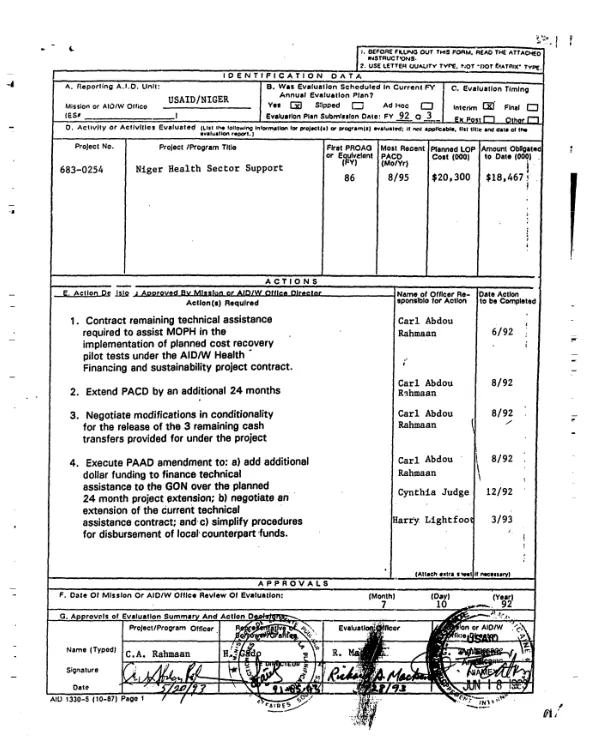
Summarizes interim evaluation (XD-ABG-401-A) of policy-based nonproject assistance (NPA) and related project assistance to Niger"s health and population sector.
1993
Sign in to readA free account is required to download.
Abstract
The evaluation covered the period 1986-5/92. Progress has been slower than anticipated at nearly every step and it will not be possible to achieve all benchmarks. Although the Grant Agreement was signed in 1986, implementation was delayed until 8/87, when conditions for the first disbursement were fulfilled. Conditions for the second tranche were achieved in mid-1990, but by then the grant had been decertified because of problems in fiscal accountability. Only in 9/91 was the second tranche actually deposited, and it is yet to be disbursed by the Government of Niger (GON). Nonetheless, the GON has made considerable progress in achieving its policy objectives, especially in family planning/population policy. Progress has also been made in conducting cost-recovery studies for non-hospitals (i.e., rural health facilities), developing methods to improve hospital cost-recovery/containment, and establishing a national health information system. Considerable analytical work has been done in other areas, but this has not yet been translated into policy or institutional reform. Nor has the transfer of skills in policy reform and planning to indigenous personnel occurred to the extent expected. The grant"s structure of benchmarks links policy areas together rather than encouraging progress in each area, and offers no direct rewards to those responsible for achieving the conditions precedent. Also, the need to focus on over 20 benchmarks in 6 areas has diffused activity and available resources and made objectives hard to achieve. The implementing institutions have contributed to these problems. The GON has been insufficiently committed to reform; USAID/N has focused on benchmarks at the expense of program objectives; and the somewhat inexperienced TA team, responding to both entities, has been overwhelmed trying to produce evidence of progress towards benchmarks in a difficult institutional environment. More work is needed to assure GON ownership of and commitment to the reforms and to improve the transfer of skills by the TA team, lest their work substitute for that of their counterparts. It is recommended that the project be extended through the end of 1994, with a focus on four policy/institutional reform areas, each with its own set of conditions precedent. Three lessons have been learned. (1) Though well designed, the grant, A.I.D."s first health sector grant, paid insufficient attention to two issues: planning for the implementation of policy reforms, and the sheer volume of the benchmarks. (2) Since government ownership is crucial to policy reform, it seems essential to improve the incentive structure by linking policy reforms directly to the release of counterpart funds. Use of a Secretariat as a mechanism for fund disbursement has ben less than satisfactory. (3) A.I.D. should begin synthesizing its experience in NPA health sector financing across other countries to assist in future planning. The Mission comments that the evaluation, while valuable in several regards, was overly negative in tone (particularly regarding the Management Secretariat) and failed to fully acknowledge one of the grant"s major accomplishments: installation of one of the most technically advanced health and management information systems in Africa. Finally, the report fails to mention that lack of continuity in the Ministry of Health executive office has been a crucial constraint.
Related documents