USAID DEC
Agriculture sector support project/private sector agribusiness sub-project (ASSP/PSA)
Sign inUSAID. MISSION TO PAKISTAN. OFC. OF THE AID REPRESENTATIVE FOR AFGHANISTAN AFFAIRS
Agriculture sector support project/private sector agribusiness sub-project (ASSP/PSA)
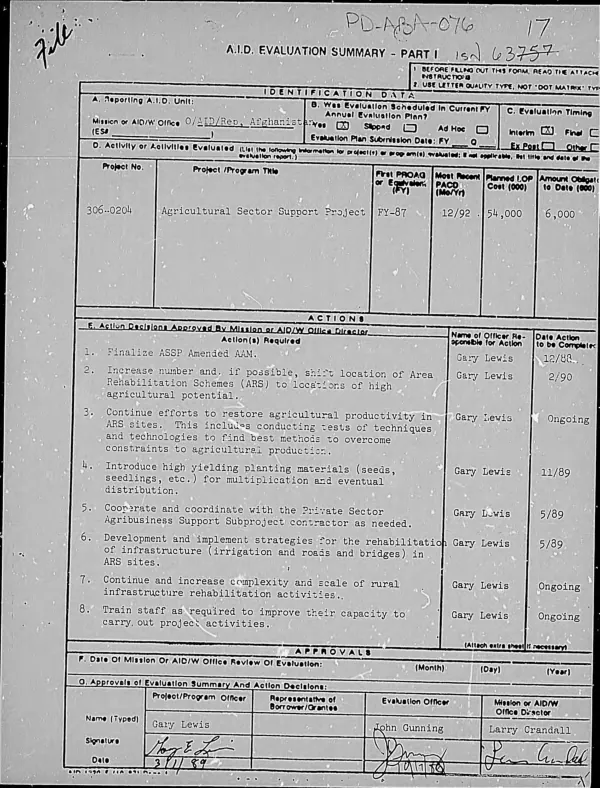
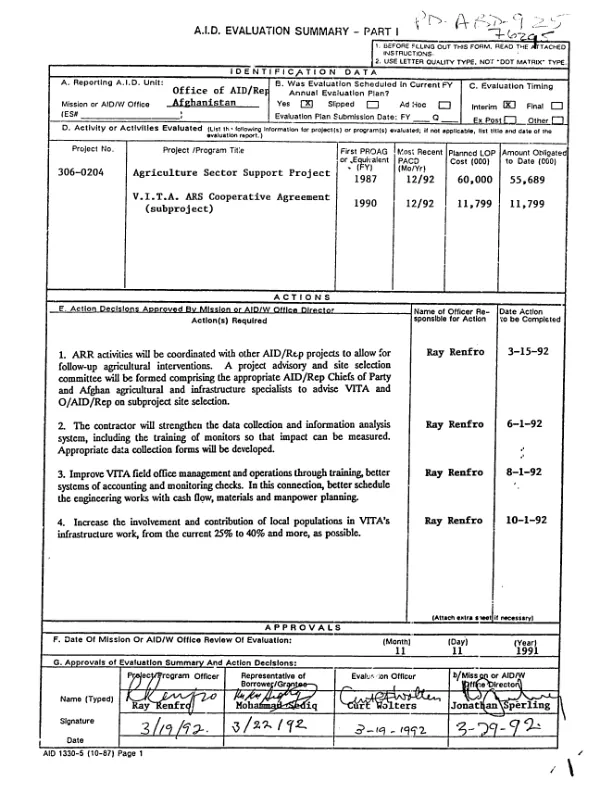
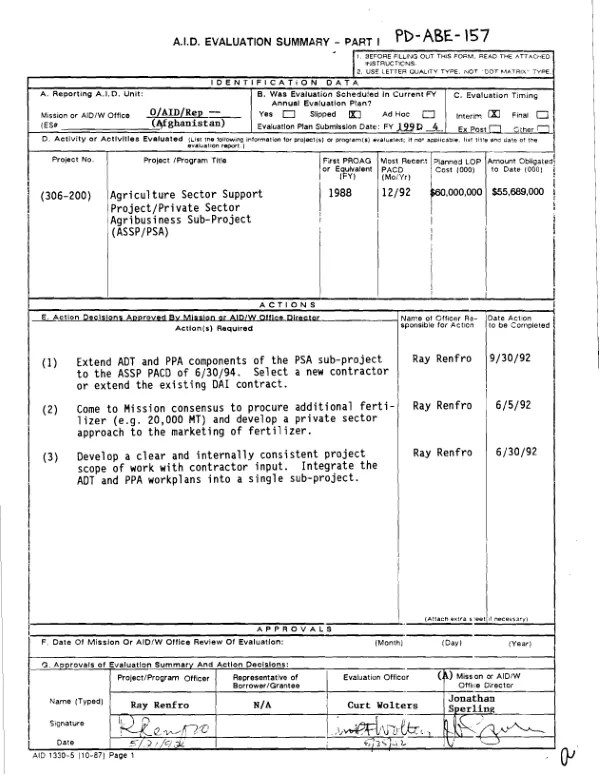
Summarizes interim evaluation (XD-ABE-157-A) of a project to promote agricultural development in Afghanistan through assistance to Pakistani and Afghan agricultural traders, data collection to improve agricultural planning, and agricultural extension.
1992
Sign in to readA free account is required to download.
Abstract
The evaluation covered the period FY88-3/92. The project has experienced numerous implementation problems, largely due to the adverse political and security situation in Afghanistan. Cross-border operations were suspended in 8/91, leading to the termination of the commercial agricultural sales component, including all fertilizer imports. Staff were evacuated from Peshawar and the project moved to Islamabad. The contractor, Development Alternatives, Inc., experienced staffing problems and frequent personnel changes, and also lacked a clear strategy for involving the private sector in both Pakistan and Afghanistan. Expectations about the ability to monitor the movement of commodities inside Afghanistan were unrealistic. Activities often received less than full support from local groups because of the inconsistent flow of inputs to farmers and traders. Despite these problems, the project has established the major structure, staffing, organization, and resources needed for implementation and is now poised to make rapid progress. Excellent relationships have been established with the donor community working in Afghanistan, particularly since the move to Islamabad. The programming, planning, and analysis component has a well-trained local staff capable of taking over much of the geographical information systems work. The agriculture development and training component is making excellent progress, providing the most direct assistance for farmers in Afghanistan. This component has the best chance of institutionalization, although it depends on the development of a better fertilizer supply mechanism and the supply of more threshers and other inputs to project centers. The component"s seed program is also functioning well and gradually expanding to other cereal crops, potatoes, and vegetables. Although the commercial agricultural sales component was terminated, it did explore various mechanisms for expanding trade between Afghanistan, Pakistan, and other free market economies. Pakistani suppliers are now more aware of the Afghan market. Several lessons were learned. (1) Activities to promote the private sector have generally been difficult, since most USAID practices conflict with the principles of private enterprise. For the commercial agricultural sales component to have succeeded, private sector agents should have been involved in project design. (2) Separating the procurement function from the TA contractor generally produces poor results, especially in specialized areas such as seeds, machinery, and computer equipment. (The OAR/A disagrees with this lesson). (3) Projects of this complexity and funding levels are designed to operate under conditions of stability and a high degree of certainty regarding conditions in the host country. (4) The project design should have allowed a greater deal of flexibility, including options to pursue if it became clear that original objectives and operating procedures were appropriate, and a rolling funding process. Such conditions are fairly common with advisors fielded under UN, World Bank, and Asian Development Bank projects. (5) A logframe should have been developed in considerable detail, and all deviations from it have been documented. The OAR/A notes that other Missions will be especially interested in the project"s experiences, positive and negative, with the use of remote sensing and computerized geographic information systems. An action decision is to extend the project to 6/94 and develop a private sector approach to fertilizer marketing.
Related documents