USAID. MISSION TO PAKISTAN. OFC. OF THE AID REPRESENTATIVE FOR AFGHANISTAN AFFAIRS
Education sector support project
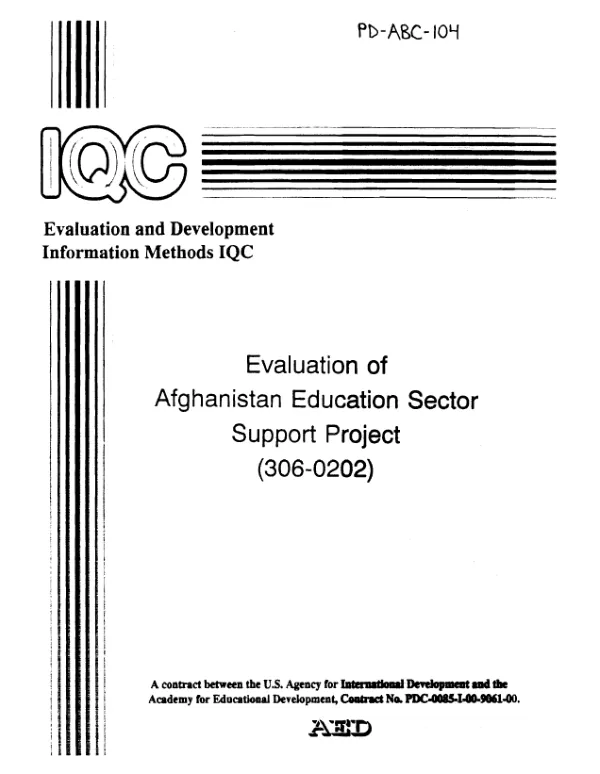
Summarizes external mid-term evaluation (PD-ABC-104) of a project to support primary schools inside Pakistan, provide literacy training for Afghan mujahedin while in Pakistan, and help Afghan political groups in Pakistan develop capabilities to administer educational programs.
1991
Sign in to readA free account is required to download.
Abstract
The project has been generally well-managed by the University of Nebraska at Omaha (UNO) and has made substantial progress despite unique and difficult conditions -- lack of a cooperating host government, and no U.S. travel in Afghanistan. (See abstract of PD-ABC-104 for information on project achievements.) The project"s success is primarily due to the high Afghan and low U.S. profiles. The U.S. TA team is comprised mainly of U.S.- trained Afghan-Americans, while the A.I.D.-created counterpart organization -- the Education Center for Afghanistan -- is staffed by Afghan political appointees. The project"s efforts to utilize culturally sensitive and knowledgeable experts has contributed to the acceptance of project textbooks by various segments of Afghan society, both inside Afghanistan and in the refugee camps. The project has operated largely in reverse sequence from normal A.I.D. education projects. For example, the process of textbook development, teacher training and guides, testing procedures, and a retrofitted curriculum is not logical. Under the circumstances, it has worked because team members recognized that the 10-year period that it took previous Afghan educational projects to reach an agreed-upon curriculum could not be duplicated in a country at war. The project"s low cost, locally printed textbooks and imaginatively produced teaching aids (silk screen cloth prints, velcro-backed number/literary boards) are transferable to primary education projects elsewhere. As Afghans move toward reconstruction, the nature of the education services provided by the project and its cooperating PVO"s will have to shift accordingly. Recommendations address: primary and secondary education; institutional development; participant training; literacy; teacher training; and job training.
Related documents