USAID. MISSION TO PAKISTAN
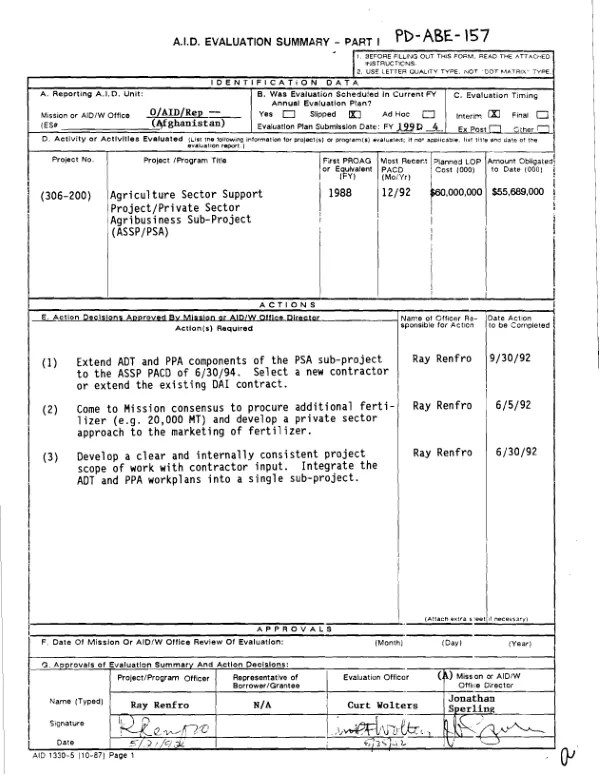
Agricultural sector support project
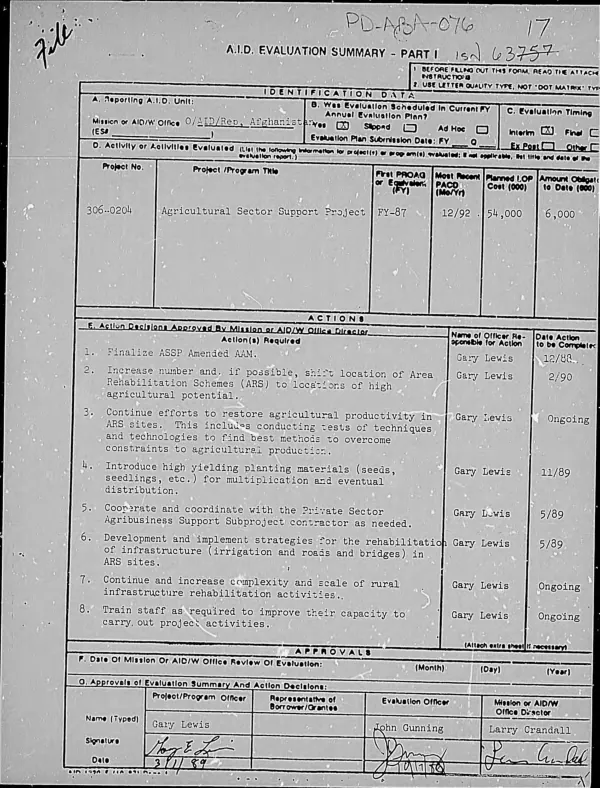
Summarizes interim evaluation (not attached) of a project to provide resources for increased agricultural activity in selected areas of Afghanistan (from a base in Peshawar, Pakistan) and to support the growth of institutions to use these resources.
1989
Sign in to readA free account is required to download.
Abstract
The evaluation covers the period 4/87-10/89. The project is the only significant cross-border program in agriculture and rural development and has made remarkable achievements in a short time. Institutions and systems have been developed to rehabilitate small-scale irrigation systems and farm-to-market roads. Volunteers in Technical Assistance (VITA), the implementing agency, has given advice to PVO"s and collaborated in the field with some of them. A small but highly successful experimental activity has been developed to distribute agricultural equipment through the private sector. The project has been somewhat less successful in developing an organized agricultural assistance program, largely because about one year was lost (through no fault of the project managers) in an unsuccessful attempt to work through the Agricultural Council of the seven-party Alliance. Once the Council collapsed, the project began to work through the Rural Works Division"s area development schemes. Only then was much accomplished in agriculture. The definition of and planning for agricultural field testing were often hampered by the limited technical expertise available from in VITA"s U.S. office. Moreover, home office problems with financial and administrative management have at times slowed field activities. Several lessons were learned. (1) The project, with a dedicated and largely Afghan staff, showed that much can be accomplished in rural infrastructure rehabilitation despite war-like conditions. (2) Private commercial channels continue to operate between Pakistan and Afghanistan and can be used to increase delivery of agricultural and construction inputs and equipment to Afghanistan. (3) Agriculture programs in Pakistan must focus on increasing production overall, not just in traditional food-deficit areas where most refugees are likely to return. (4) Area Development Schemes are an effective framework for undertaking agricultural and infrastructural rehabilitation activities in specific and limited geographic areas.
Related documents