FINTRAC
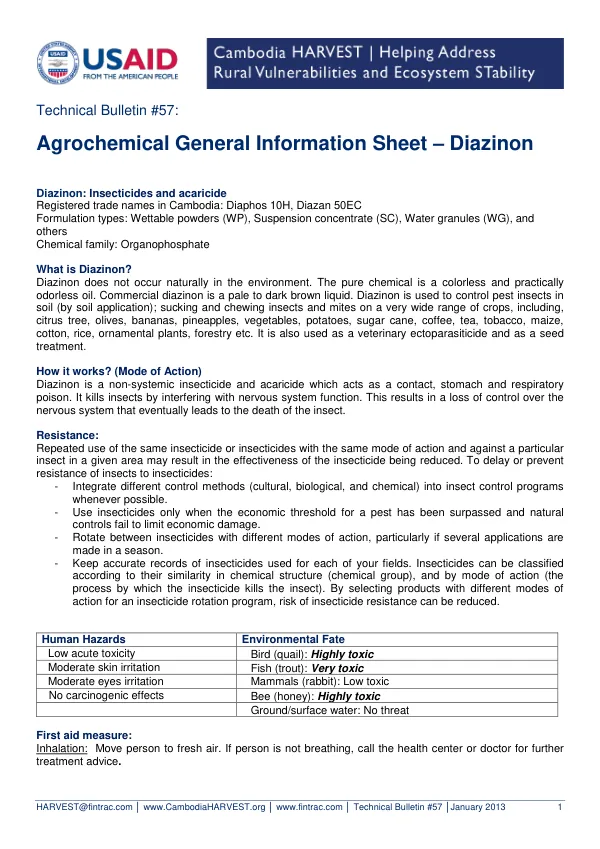
Agrochemical General Information Sheet - Glyphosate
Glyphosate is a non-selective systemic herbicide that controls both broadleaf plants and grasses.
2011 · 3 pages
Sign in to readA free account is required to download.
Abstract
Most glyphosate herbicides contain the isopropylamine (IPA) salt of glyphosate. A related chemical, the sodium salt of glyphosate, is used to regulate plant growth in sugar cane and peanut and ripen fruit. Glyphosate works by being absorbed by leaves and rapidly moving through the plant. It prevents the plant from producing amino acids that are the building blocks of plant proteins. The plant, unable to make proteins, stops growing and dies over a period of four to 20 days. If the chemical is transported throughout the plant, usually no part survives. Glyphosate resistance occurs where glyphosate is used intensively, few or no other herbicides are used, and there is no control of survivors of glyphosate application. Reducing the risk of glyphosate resistance requires action in the whole of the rotation. In planning the use of herbicide, it is essential to choose the type most appropriate for the situation, taking into account soil type, rainfall, and weed spectrum and herbicide-resistance risk. Glyphosate has very low toxicity for humans, but some solvents used in the formulation can be more toxic than the glyphosate itself. The chemical has been classified as low/moderate acute toxicity. Bird (quail) studies have shown slightly toxic effects, while fish (trout) and bee (honey) studies have shown non-toxic effects. Ground/surface water may be at risk of contamination from spray drift. Mitigation measures are essential to minimize the risks associated with glyphosate use. These measures include wearing personal protective clothing for applicators, mixing and cleaning chemical tanks in designated areas, and avoiding application near open water sources. It is also crucial to implement integrated pest management practices and rotate chemicals to reduce the risk of herbicide resistance. The recommended usage rates for glyphosate/IPA salt vary depending on the specific weed species and application method. For example, the recommended rate for controlling Cyperus rotundus is 4-6L/50-120 L of water/ha, while the recommended rate for controlling Cynodon dactylon is 2-3L/40-60L of water/ha.
Related documents