USAID DEC
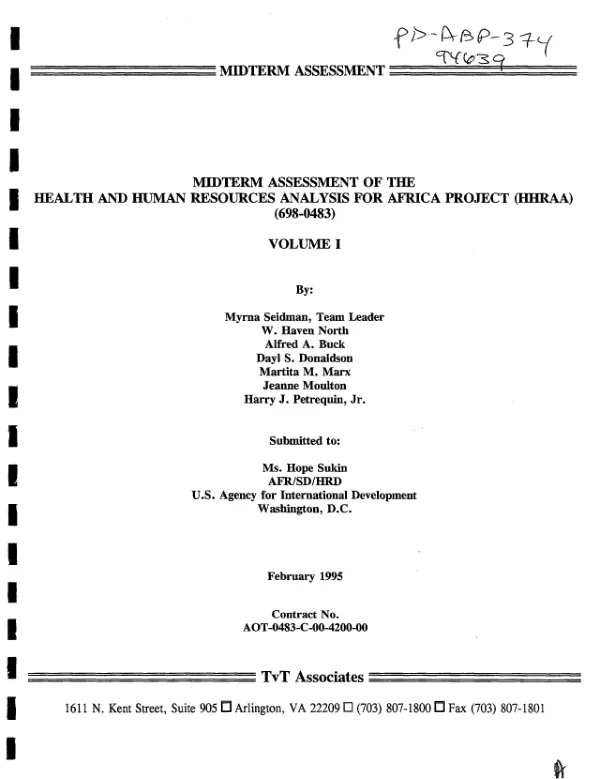
AID contract no. AOT-0483-C-00-2178-00 with the Academy for Educational Development to support health and human resources (HHR) research and analysis in Africa and to ensure that findings are effectively disseminated for use by African policy makers and program managers primarily, as well as by AID missions and other donors involved in HHR development [SARA project]
Sign inUSAID. BUR. FOR AFRICA. OFC. OF ANALYSIS, RESEARCH AND TECHNICAL SUPPORT
AID contract no. AOT-0483-C-00-2178-00 with the Academy for Educational Development to support health and human resources (HHR) research and analysis in Africa and to ensure that findings are effectively disseminated for use by African policy makers and program managers primarily, as well as by AID missions and other donors involved in HHR development [SARA project]
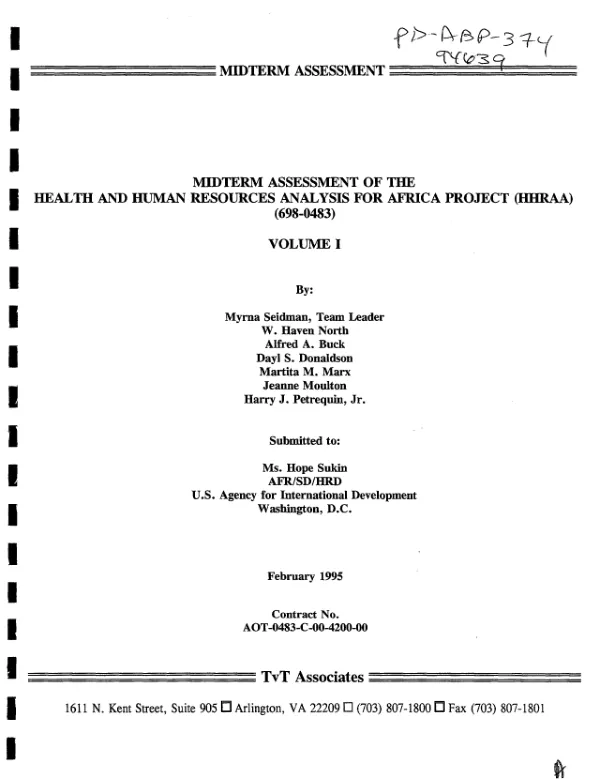
Contract with the Academy for Educational Development (AED) to support a project to increase the utilization of research and analyses for policy and program development and evaluation in the health and human resources sectors in sub-Saharan Africa (HHRRA project).
1992
Sign in to readA free account is required to download.
![AID contract no. AOT-0483-C-00-2178-00 with the Academy for Educational Development to support health and human resources (HHR) research and analysis in Africa and to ensure that findings are effectively disseminated for use by African policy makers and program managers primarily, as well as by AID missions and other donors involved in HHR development [SARA project]](https://covers.devme.ai/gen/75697.webp)
Abstract
HHRRA, which is being managed by the Africa Bureau"s new Office of Analysis, Research, and Technical Support (AFR/ARTS), comprises two components: (1) research and analysis, and (2) dissemination of results. AED will provide technical support and backstopping to activities in these areas, including development of management information and project monitoring systems. This AED support contract is referred to as the SARA project. Under the first component, the project will support 10-12 research and analytic activities each year. Efforts will fall into five analytic domains: service delivery, sector policy, sector financing, human behavior (at the household level), and high impact strategy development (for priority issues such as HIV/AIDS, malaria, and population growth). These issues may be researched through literature reviews, syntheses of lessons learned, analyses of secondary data, short-term field studies, and occasionally, long-term multi-country studies. Research will be carried out primarily by ongoing R&D projects and contractors. The research agenda-setting process will engage the participation of African institutions (public and private), REDSO"s, Missions, and other international organizations. The second component will disseminate the findings of project research to African policymakers and program managers, as well as to A.I.D. and other international donors through workshops, publications, TA, and other activities. Each research finding will be disseminated through more than one modality to ensure maximum exposure. As in the first component, African counterparts (both individual and institutions) will participate in all activities. AED will provide technical support and backstopping to the above activities, including development of management information and project monitoring systems. The project is expected to contribute to improved resource allocation, strategies, policies, and programs in the health and human resources sectors of at least 15 African countries. Among other areas, it is expected that African strategies for malaria, nutrition, HIV/AIDS, urban health, and primary education will be developed or modified as a result of this project.
Related documents
![Health and human resources analysis for Africa (HHRAA) : volume II -- additional annexes [F through M]](https://covers.devme.ai/gen/84809.webp)