USAID DEC
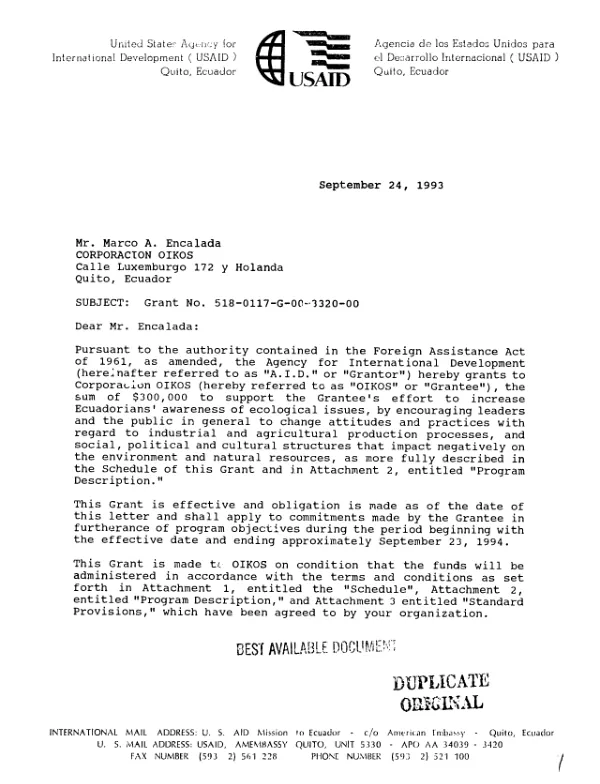
AID grant agreement no. 518-0117-G-00-3320-00 with Corporacion OIKOS in support of OIKOS" efforts in the strengthening of the environmental education and technology project (EDUCAR)
Sign inUSAID. MISSION TO ECUADOR
AID grant agreement no. 518-0117-G-00-3320-00 with Corporacion OIKOS in support of OIKOS" efforts in the strengthening of the environmental education and technology project (EDUCAR)
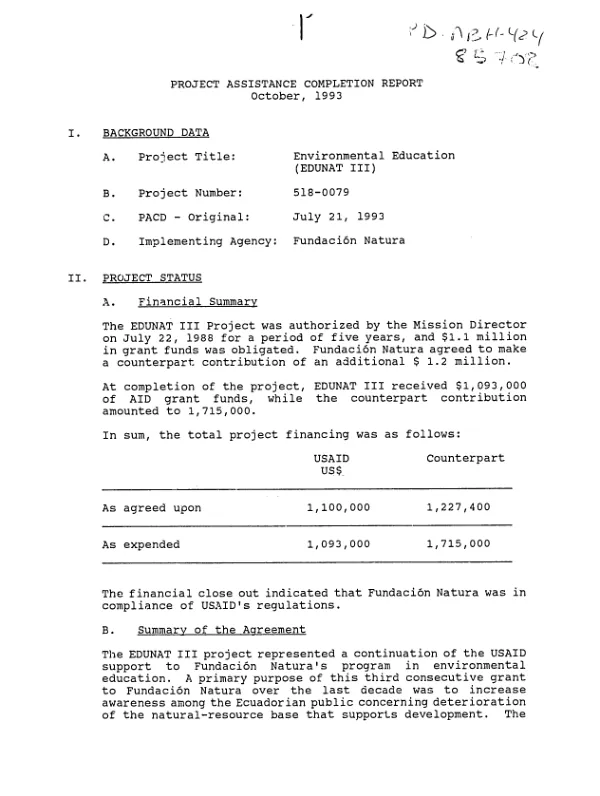
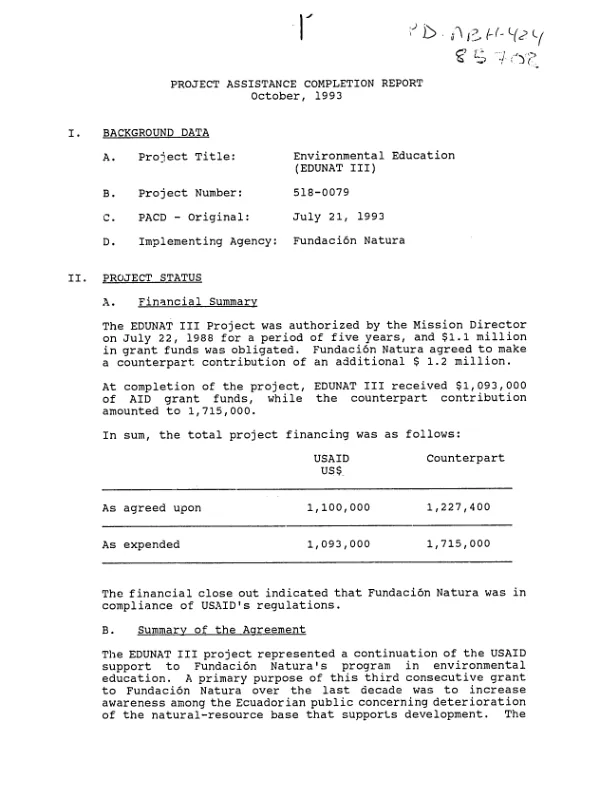
Project, follow-on to 5180079 (EDUNAT project), to increase Ecuadorians" awareness of ecological issues.
1993
Sign in to readA free account is required to download.
Abstract
The project will be implemented by Corporacion OIKOS, a nascent NGO created in 1992 by EDUNAT participants, and includes three components: (1) studies and pilot projects for environmental technology transfer and marketing, (2) environmental education; and (3) OIKOS institutional support. Under the first component, OIKOS will complete the following studies: (1) a study on the specific needs for environmental technology in high-pollution industries; (2) a pre-feasibility study for a nonprofit "ecological bank" to finance the transfer and adoption of environmental mitigation technologies; (3) a feasibility study for creating a training institute for areas relating to the transfer of environmental technologies; and (4) an inventory of national and international institutions and individuals that can provide Ecuador with needed environmental information, both scientific and technological. OIKOS will also carry out two pilot projects: (1) an on-site advisory system for industrialists considering the adoption of environmental technologies; and (2) a series of roundtables to stimulate the supply of and demand for environmental technologies for industry. The educational component will be implemented in the school system and through mass media. Activities will include an ongoing knowledge, attitudes, and practices (KAP) survey regarding environmental problems, along with dissemination of information about solutions and alternatives via radio and TV spots, posters, pamphlets, and seminars and workshops. OIKOS will work closely with the Ministry of Education (MOE) to ensure that environmental education is integrated into the national curricula, and will train MOE staff in the production of pedagogic materials on environmental education. OIKOS will also offer training workshops for 3,000 preschool teachers and 50% of national school teachers, design didactic materials and posters for preschoolers, and develop an environmental module for secondary school students. Under the third component, the project will provide computer equipment and TA to help OIKOS develop policies governing its personnel, relations with donors and development partners, and environmental agenda; planning and financing for self-sustainability; and administrative bases for an information and records center operative at both the local and national levels.
Related documents
Documents in this collection
 1997
1997USAID DEC
Ecuador : environmental education and technology transfer program -- pollution prevention
Open record 1986
1986USAID DEC