USAID. MISSION TO ECUADOR
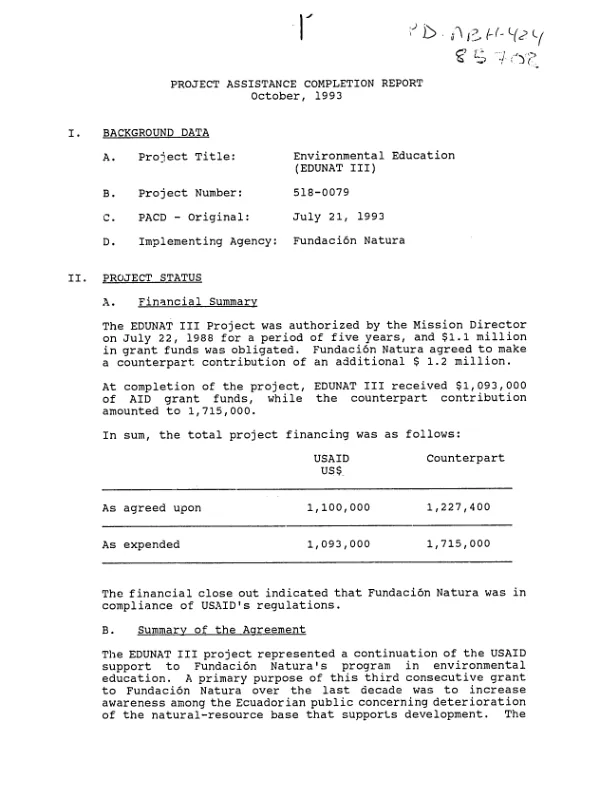
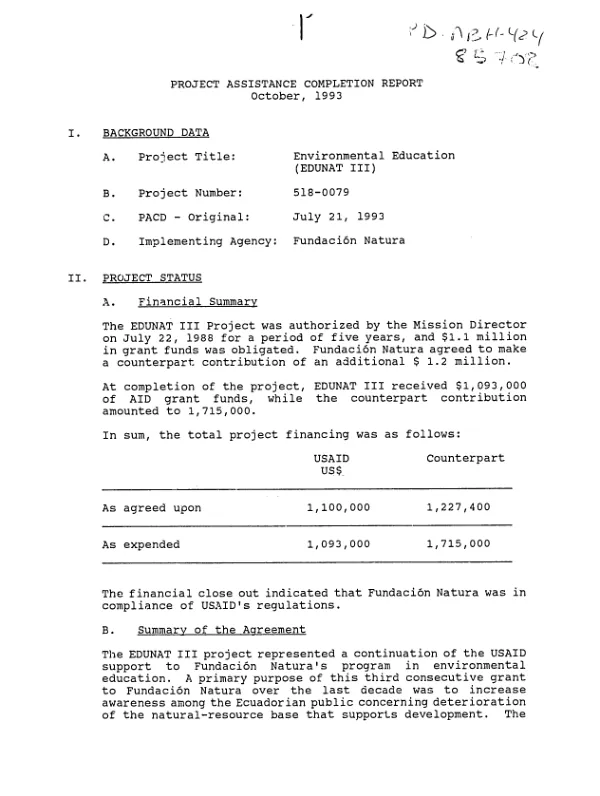
Project assistance completion report : environmental education (EDUNAT III)
PACR on a grant (4/88-4-93) to Fundacion Natura (FN), an Ecuadorean PVO, to expand environmental education and awareness in Ecuador.
1993
Sign in to readA free account is required to download.
Abstract
This was the third consecutive such grant to FN, and focused on increasing public awareness of the deterioration of the natural resource base. The project was successful in all its targeted areas, with the greatest success in the area of formal environmental education, which was institutionalized in Ecuador's school system in 6/89. FN organized ecological clubs for high school students; distributed a total of more than 300,000 copies of instructional materials and teachers' manuals for the preschool, primary, and secondary school levels; and trained more than 40,000 teachers in delivering environmental education. The financial contribution by the Ministries of Health, Social Welfare, and Education toward this component was three times that of the grant. Under the environmental awareness component, an environmental knowledge, attitudes, and practices survey was completed; 780 press releases were distributed to major national newspapers; 60 radio spots were broadcast on 120 radio stations; and several books and pamphlets were published. Five hundred public leaders attended 20 environmental awareness seminars, 10 of which dealt with specific issues such as industrial pollution, agriculture and the environment, and contamination of the Machangara River. The other 10 seminars dealt with the drafting of a national environmental law which is currently under consideration. Under the industrial pollution component, FN prepared a report on industrial processes, which heightened public awareness of industrial pollution. FN also identified the effluents of over 39 types of industries; the information has been widely disseminated, and FN has worked with the government to develop norms and regulations for effluent disposal. In addition, five municipalities in El Oro province were assisted in developing ordinances to prevent contamination from gold mining. Under the community development component, secondary school students in Quito distributed and explained an educational document on proper garbage handling, resulting in improvements in the appearance of city streets; 130 member municipalities of the Ecuadorian Association of Municipalities (AME) received training in environmental concerns (these are now dealt with extensively in AME's own training program); and 500 community development institutions were provided with training in environment and development. Finally, FN developed a document center which houses over 12,000 documents and 770 periodicals and is used by over 300 people each month -- primarily high school and university students, although other groups, such as professors and government personnel, also use the center. The following lessons were learned. (1) The project's success was due its evolution, in three phases, over a 10-year period; changes in attitudes and behavior take time. (2) While evaluations found this project to be successful, a lack of measurable benchmarks made it difficult for the evaluators to provide solid evidence of this achievement. (3) NGOs should offer employment conditions that attract and hold experienced professionals, perhaps through convergence with the private for-profit sector in the areas of management and entrepreneurial pursuit of funding.