USAID DEC
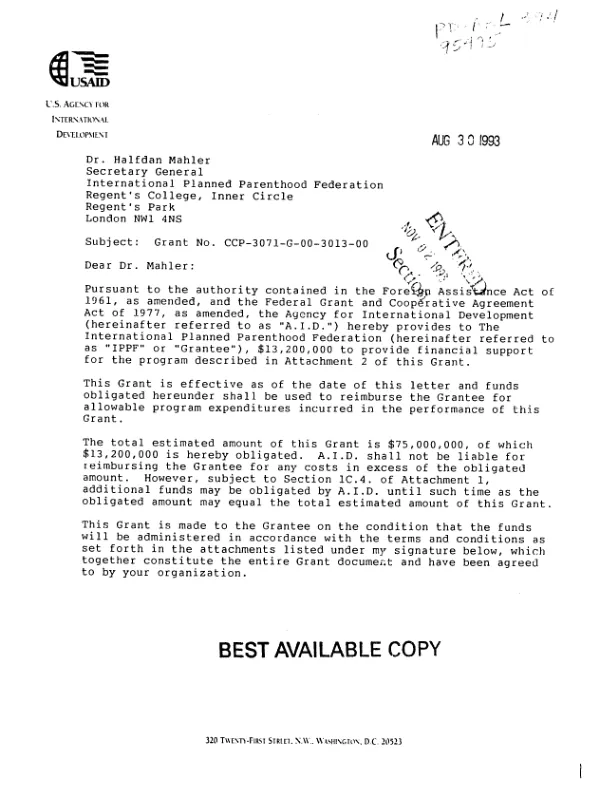
AID grant agreement no. CCP-3071-G-00-3013-00 to the International Planned Parenthood Federation (IPPF) in support of its proposal to introduce, expand, and improve family planning information and service through its extensive affiliated network of indigenous family planning associations, dated April 26, 1993
Sign inUSAID. BUR. FOR RESEARCH AND DEVELOPMENT. OFC. OF POPULATION
AID grant agreement no. CCP-3071-G-00-3013-00 to the International Planned Parenthood Federation (IPPF) in support of its proposal to introduce, expand, and improve family planning information and service through its extensive affiliated network of indigenous family planning associations, dated April 26, 1993
Grant to the International Planned Parenthood Foundation (IPPF) to improve family planning (FP) information and service delivery through IPPF"s worldwide network of affiliated FP Associations (FPAs).
1993
Sign in to readA free account is required to download.
Abstract
The grant will support IPPF"s core programs and enable IPPF to establish a competitive grant mechanism for selected FPAs, called the Partnership Challenges Fund (PCF). Approximately half of the grant funds will be used for core technical support to affiliated FPAs worldwide in carrying out the strategies described in IPPF"s Strategic Plan (Vision 2000). USAID"s contribution to the Core Fund will enable IPPF to help FPAs improve their program strategy and management capabilities, particularly those FPAs that are not strong enough to compete for PCF resources. The other half of the grant will be used to establish the PCF, under which IPPF will provide, on a competitive basis, grants to challenge selected FPAs to improve their performance. Compared to IPPF"s core funding, the PCF will be less concerned with providing long-term support to FPA"s and more concerned with investments that yield high impact and measurable results. Priority will be given to FPAs in Africa, South Asia, East and Southeast Asia, and Oceania. Grants will range from $100,000 to $1 million, or more, for projects lasting 3-5 years. The PCF will fund projects that stress: (1) improved or expanded service delivery to reduce unmet needs, e.g., by targeting hard-to-reach or marginal groups or population subgroups such as males or adolescents, reducing unnecessary medical barriers to FP, improving service availability through social marketing, training public and private providers (including NGOs), reducing service complications and drop-out rates, or improving client satisfaction and quality of care; (2) advocacy and information, education, and communication (IEC), e.g., programs to improve the policy climate and reduce barriers to service delivery, sex education programs, and programs for specific underserved populations; (3) innovative and experimental programming, such as operations research, information gathering on the magnitude of a particular unmet need, and efforts to increase community and especially women"s participation in program design and management; (4) efforts to upgrade FPA management and strategic planning, e.g., by increasing the proportion of women involved in decision making; (5) promotion of North-to-South and/or South-to-South collaboration.
Related documents
Documents in this collection
 1991
1991USAID DEC
AID cooperative agreement no. DPE-3058-A-00-1011-00 with Cooperative for American Relief Everywhere (CARE) to support CARE"s population and family planning expansion activities in the developing world and especially in sub-Saharan Africa
Open record 1989
1989USAID DEC

![AID grant no. 688-0247-G-[00]-3442-00 to Save the Children Federation/USA for a program of promotion of family planning and AIDS awareness in Mali](https://covers.devme.ai/gen/42711.webp)