USAID DEC
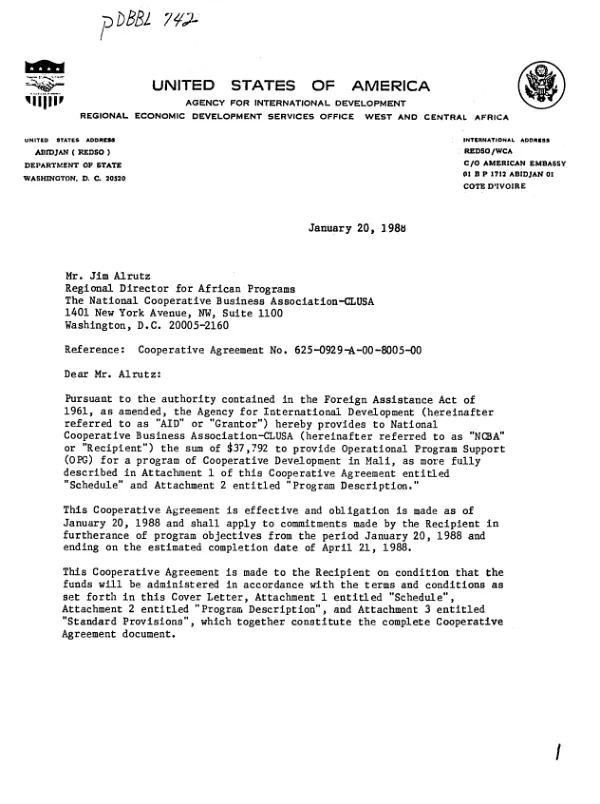
AID grant no. 688-0259-G-SS-9048-00 to World Vision Relief and Development, Inc. to assist nomadic herdsmen in the Sahelian region of Mali to return to self-sufficiency in livestock production after prolonged dependence on food aid
Sign inUSAID. BUR. FOR AFRICA. REGIONAL ECONOMIC DEVELOPMENT SERVICES OFC. (REDSO) WEST AND CENTRAL AFRICA
AID grant no. 688-0259-G-SS-9048-00 to World Vision Relief and Development, Inc. to assist nomadic herdsmen in the Sahelian region of Mali to return to self-sufficiency in livestock production after prolonged dependence on food aid
Grant to World Vision Relief and Development (WVRD) for a pilot project to help 15,000-20,000 destitute Tamashek pastoralists in Menaka Cercle in Mali"s Sahelian zone resume their transhumant lifestyle after long dependency on food aid.
1989
Sign in to readA free account is required to download.

Abstract
The project is comprised of a short-term program to rebuild livestock herds and a long-term program to regenerate lands devastated by drought by upgrading existing water points ("oases"). Under the herd rebuilding component, WVRD will acquire livestock from surplus zones in Menaka Cercle, using food aid as barter, and then loan small breeding herds (4 sheep, 5 goats, as well as a donkey for transport) to 330 needy families who lost their own animals during the 1984-85 drought, in 22 zones of the Cercle. Borrowing families, which will also receive food aid sufficient to supply half their food needs for 6 months, will repay the in-kind loan within 3 years, and the repayment animals will be loaned to a second generation of beneficiaries. Other aspects of the herd rebuilding component will include: (1) establishing temporary dry season reserves around permanent water sources to assure good grazing near water during arid months; (2) involving livestock cooperatives or herder organizations in the herd loan program; (3) training 2 herders from each of the 22 zones to act as model herders and extensionists; (4) improving pasture and forage production by collecting fonio straw, establishing nurseries for the aquatic plant echinocloa stagnina, adapting fonio and other pasture species, and testing feed supplements; (5) supporting government animal vaccination programs; and (6) gathering data on rainfall, herd movements, prices, and animal health. Using food for work as a key resource, the land generation component will construct appropriate soil and water conservation works at 35 oasis sites, including half-moon microcatchments, rock filter dikes, subsurface dams, and contour rock bunds; construction of new or improved cement reinforced shallow wells is also planned. Villagers will be trained to participate in land regeneration activities. In addition, various indigenous acacia varieties, as well as wild date, date palm, guava, citrus, and eucalyptus will be transplanted to the oasis sites for use as dikes and for wood/fuel production; and the population will be taught to collect and plant Euphorbia balmisfera starts for use in dune fixation and live fencing. Other activities include management planning and protection for the Tin Abao-Menaka Forest, and the planting and storage of recession sorghum, an excellent "hungry season" food, at 20 sites. It is expected that the 35 oasis sites to be upgraded under the project will become focal points for other project and government services, e.g., literacy training.
Related documents