USAID DEC
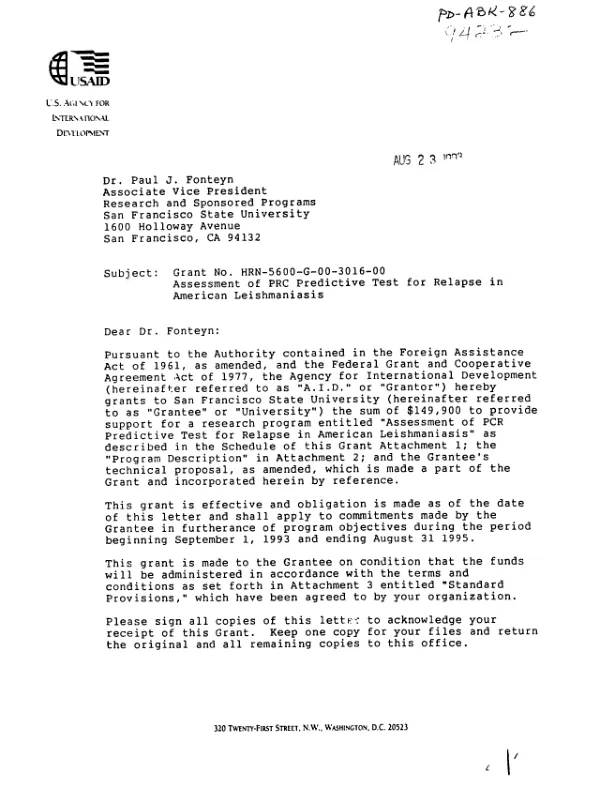
AID grant no. HRN-5600-G-00-3023-00 to the University of New Mexico for the development of safe, sustainable methods of controlling schistosomiasis in Kenya
Sign inUSAID. BUR. FOR RESEARCH AND DEVELOPMENT. OFC. OF RESEARCH
AID grant no. HRN-5600-G-00-3023-00 to the University of New Mexico for the development of safe, sustainable methods of controlling schistosomiasis in Kenya
Grant is provided under the Innovative Scientific Research II project to the University of New Mexico to test the hypothesis that the crayfish Procambarus clarkii can help reduce transmission of Schistosoma mansoni, by preying on the disease"s snail vectors, to people in selected living selected waterbodies in central Kenya.
1993
Sign in to readA free account is required to download.
Abstract
The overall strategy is as follows. Experimental and control sites will be selected, and a subset of children known to be infected with S. mansoni will be selected for further study. An intervention phase will begin with the introduction of crayfish at experimental sites. Once the crayfish have been established, the children specified will be treated to eliminate infection and then be monitored to determine if they become reinfected. Control and experimental sites will then be compared with respect to snail densities and prevalence of infected snails, and most important, rates of reinfection in the selected sample of children. During a post intervention stage, all infected persons in all study sites will be offered treatment. If the use of crayfish succeeds in reducing snail populations and schistosomiasis transmission in experimental sites, crayfish will also be introduced into the control sites.
Connected topics
Related documents
Documents in this collection
 1991
1991USAID DEC
AID grant no. 615-0259-G-SS-00-1071-00 to the University of Nairobi to provide support to a research program entitled `identification of protective and/or diagnostic antigens of schistosoma haematobium"
Open record 1970
1970USAID DEC