USAID DEC
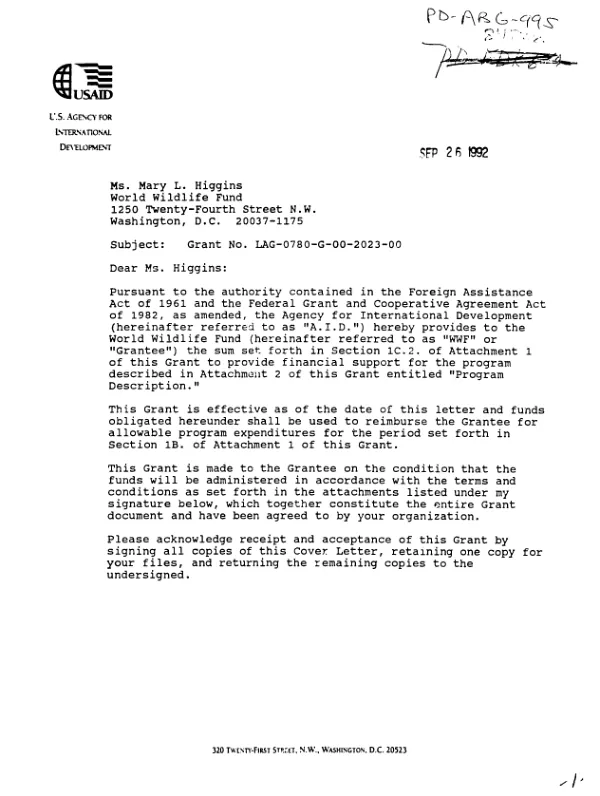
AID grant no. LAG-0780-G-00-2023-00 to World Wildlife Fund for a program entitled `conservation and sustainable resource use in the Colombian Choco"
Sign inUSAID. BUR. FOR LATIN AMERICA AND THE CARIBBEAN
AID grant no. LAG-0780-G-00-2023-00 to World Wildlife Fund for a program entitled `conservation and sustainable resource use in the Colombian Choco"
Grant is provided under the Environmental Support Project (5980780) in Latin America to World Wildlife Fund (WWF) to promote community-based conservation and sustainable use of the biological resources of Colombia"s ecologically threatened Choco region, along the Pacific Coast.
1992
Sign in to readA free account is required to download.
Abstract
The grant will enable WWF to develop diagnostic and baseline information on selected areas of the Choco, continue three field projects in the region, and identify new areas of biological importance, threat, and opportunity. WWF"s first objective is to provide a better base of information on the status of the forest cover, the presence of communities, and existing activities. Focusing on three geographic areas in the central and central north Choco (Awa Territory, Rio Tatabro-Bajo Anchicaya, and Bahia Malaga), WWF will collaborate with Fundacion Herencia Verde (FHV) to: (1) examine forest cover and condition of vegetation through an analysis of satellite imagery and ground truthing, to be conducted in full collaboration with local communities; (2) assess the biological diversity of selected sites through studies of the abundance and richness of butterfly species as biological indicators, and through assessments of potentially useful species as perceived by local residents; and (3) identify opportunities for new conservation initiatives by examining land tenure and the potential for the establishment of community management, multiple use reserves, and assessments of community organizations. The same type of information will be collected for Utria Sound National Park in collaboration with Fundacion Natura. In three of the four above-mentioned areas (Rio Tatabro-Bajo Anchicaya, Bahia Malaga, and Utria Sound National Park), the grant will also fund WWF activities to further consolidate existing projects through strengthened collaboration with local communities, environmental education, and training. WWF, its indigenous NGO partners, and the local ethnic groups will develop alternative options for resource management and income generation that are less destructive than, for example, existing mining activities and planned infrastructure build-ups. Targets include: establishment of special management zones for sustainable resource use; improved/expanded production of alternative crops and products (e.g., organic banana, ornamentals); adoption of new agricultural management methods; evaluation of potential for natural forest management within two sites (Bahia Malaga and Rio Tatabro); and strengthened community organizations as evidenced by new members and activities.
Related documents
Documents in this collection
 1992
1992USAID DEC
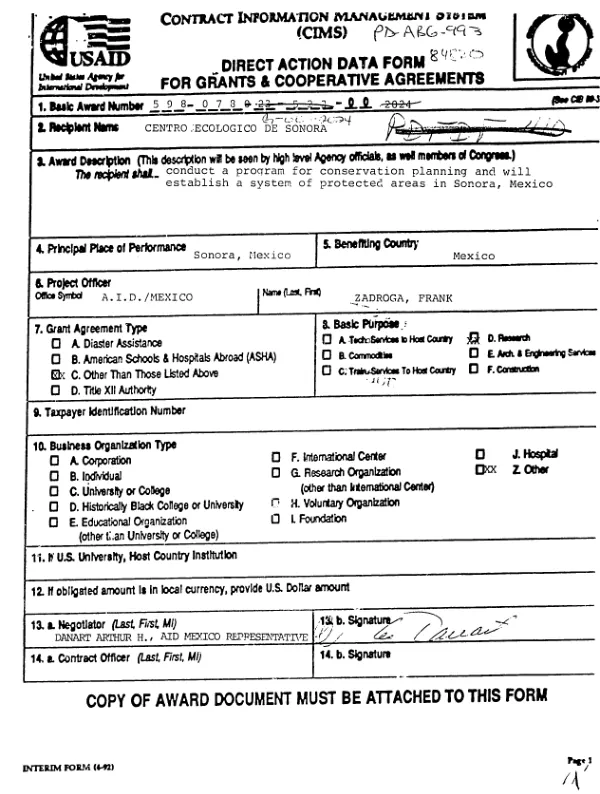
AID grant no. 598-0780-G-00-2024-00 to Centro Ecologico de Sonora to conduct a program for conservation planning and establish a system of protected areas in Sonora, Mexico
Open record 1992
1992USAID DEC
![Modification [no. 2] of grant/agreement [no. 879-0023-A-00-1241-00 to the Foundation for the People"s of the South Pacific for the profitable environmental protection project]](https://covers.devme.ai/gen/49205.webp)