USAID. MISSION TO PHILIPPINES
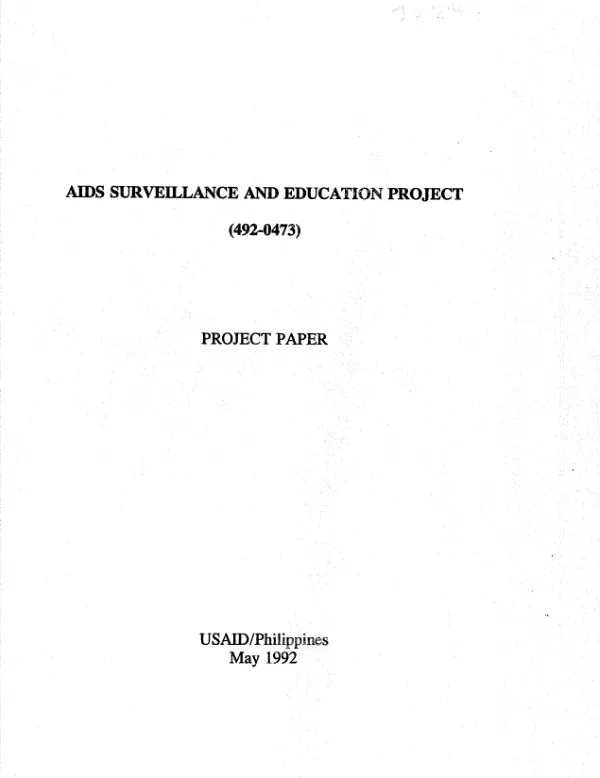
AIDS surveillance and education project
Project to establish public and private sector mechanisms to control the spread of AIDS in the Philippines.
1992
Sign in to readA free account is required to download.
Abstract
The project, to be implemented under the aegis of the Department of Health (DOH), will: (1) establish an HIV sentinel surveillance system, and (2) working largely through NGO"s, support a community-based information, education, and communication (IEC) program. The project will establish a sentinel surveillance system that involves the collection of blood samples for HIV testing from designated groups at risk in strategically located geographic sites throughout the country. The system, which will cover 30 urban centers (14 within the first 3 years), will initially focus on four high-risk groups: (1) returning overseas contract workers, (2) homosexual males, (3) commercial sex workers, and (4) patients at sexually transmitted disease clinics. Once a threshold prevalence has been reached among one or more of these groups, the system will be expanded to include four secondary risk groups: intravenous drug users, women attending pre-natal clinics, spouses of overseas contract workers, and partners of commercial sex workers. Blood testing will be conducted at DOH regional laboratories using the ELISA test or the particle agglutination test under the supervision of the Bureau of Research and Laboratories. The Research Institute for Tropical Medicine will confirm all positive HIV tests via the Western Blot procedure. An external reference laboratory will provide a source of expertise and validation. The project will fund equipment, tests, reagents, short-term TA, domestic training, research, and various operational costs. The IEC program will encourage behavioral change among both high- risk groups and the general population. The program will be implemented first in Metro Manila, and later at three other sites identified by the sentinel surveillance program as problematic. The first activity will be development of a National AIDS Prevention and Control Strategy. The project will use a community-based, multi-media approach, comprising mass media and interpersonal channels supplemented by public relations channels and incorporation of IEC messages into entertainment programs. Target audiences fall into three categories: influentials (e.g., policymakers, clergy, entertainers); channels (e.g., teachers, health workers); and behaviorals, i.e., high-risk groups. A network of NGO"s will be utilized to undertake training, education, counseling, and outreach to hard-to-access groups. The project will fund, inter alia, TA for participating NGO"s, training, telephone hotlines, lifestyle research, a condom social marketing campaign, counseling and outreach programs, and advertising and promotional campaigns.
![AIDS communications and technical services (ACTS) (supplement) [: amendment no. 1] -- phase two plan of activities](https://covers.devme.ai/gen/29655.webp)
![FLAS/[HOPE] HIV AIDS prevention project](https://covers.devme.ai/gen/24881.webp)