PATH
AIDSFree Prevention Update
The AIDSFree Prevention Update is a monthly publication that provides a snapshot of current peer-reviewed literature and state-of-the-art program resources, tools, and curricula on HIV prevention.
2015 · 124 pages
Sign in to readA free account is required to download.
Abstract
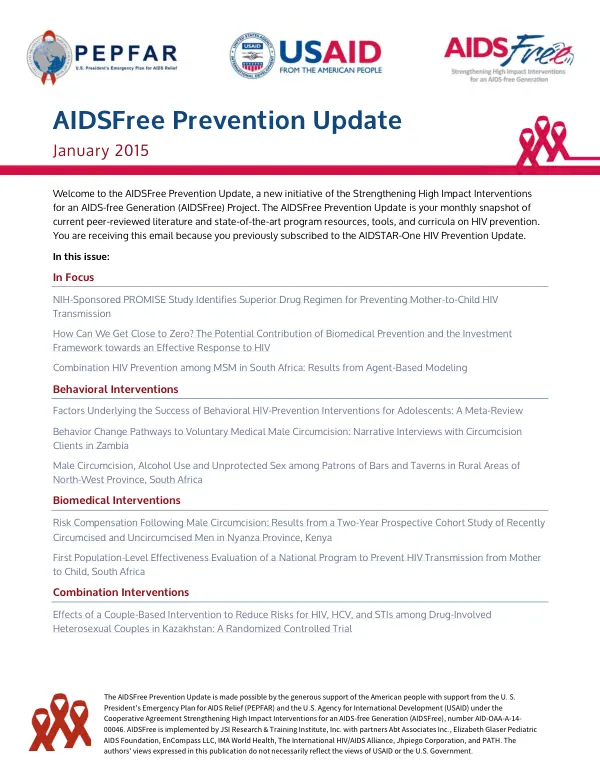
The publication is sponsored by the Strengthening High Impact Interventions for an AIDS-free Generation (AIDSFree) Project, which is funded by the U.S. President's Emergency Plan for AIDS Relief (PEPFAR) and the U.S. Agency for International Development (USAID). The January 2015 issue of the AIDSFree Prevention Update focuses on various aspects of HIV prevention, including biomedical interventions, combination interventions, and behavioral interventions. One of the key studies highlighted in the issue is the NIH-sponsored PROMISE study, which compared the safety and effectiveness of three drug regimens for preventing mother-to-child HIV transmission. The study found that the lamivudine combination was the safest and most effective regimen, with a seroconversion rate of 0.5 percent among infants whose mothers received this regimen. Another study discussed in the issue is the agent-based modeling study on combination HIV prevention among men who have sex with men (MSM) in South Africa. The study found that a four-component HIV prevention package consisting of antiretroviral therapy (ART), pre-exposure prophylaxis (PrEP), behavioral interventions, and campaigns to increase HIV testing could prevent about 34 percent of HIV infections over a five-year period. The issue also highlights the importance of behavioral interventions in reducing HIV risk-taking behaviors among adolescents. A meta-review of quantitative and qualitative reviews found that successful HIV prevention interventions for adolescents aged 10-19 often included behavior change techniques, participant characteristics, design features, and socio-ecological features. The AIDSFree Prevention Update is a valuable resource for policymakers, program managers, and researchers working in the field of HIV prevention. The publication provides a comprehensive overview of the latest research and programmatic innovations in HIV prevention, and highlights the importance of a combination approach to preventing HIV infection. The publication is made possible by the generous support of the American people, with funding from PEPFAR and USAID under the Cooperative Agreement Strengthening High Impact Interventions for an AIDS-free Generation (AIDSFree), number AID-OAA-A-14-00046. The AIDSFree project is implemented by JSI Research & Training Institute, Inc. with partners Abt Associates Inc., Elizabeth Glaser Pediatric AIDS Foundation, EnCompass LLC, IMA World Health, The International HIV/AIDS Alliance, Jhpiego Corporation, and PATH. The authors' views expressed in this publication do not necessarily reflect the views of USAID or the U.S. Government. The publication is intended to provide information and resources for HIV prevention programs, and is not intended to be a comprehensive review of all HIV prevention research and programmatic innovations. The publication highlights the potential contribution of biomedical prevention and the investment framework towards an effective response to HIV. A study by Stover, Hallett, and Wu modeled the impact of three new prevention technologies: test and treat (T&T), pre-exposure prophylaxis (PrEP), and HIV vaccination in 24 countries that account for 85 percent of new infections. The study found that expanding ART coverage in line with the World Health Organization's (WHO) 2013 treatment guidelines could reduce annual new infections by 83 percent by 2050. The publication also discusses the importance of structural interventions in preventing HIV infection. A study on the impact of SASA!, a community mobilization intervention, on reported HIV-related risk behaviors and relationship dynamics in Kampala, Uganda found that the intervention was associated with reduced HIV-related risk behaviors and improved relationship dynamics. Overall, the AIDSFree Prevention Update is a valuable resource for anyone working in the field of HIV prevention. The publication provides a comprehensive overview of the latest research and programmatic innovations in HIV prevention, and highlights the importance of a combination approach to preventing HIV infection.
Related documents