BANK FOR WEST AFRICAN DEVELOPMENT
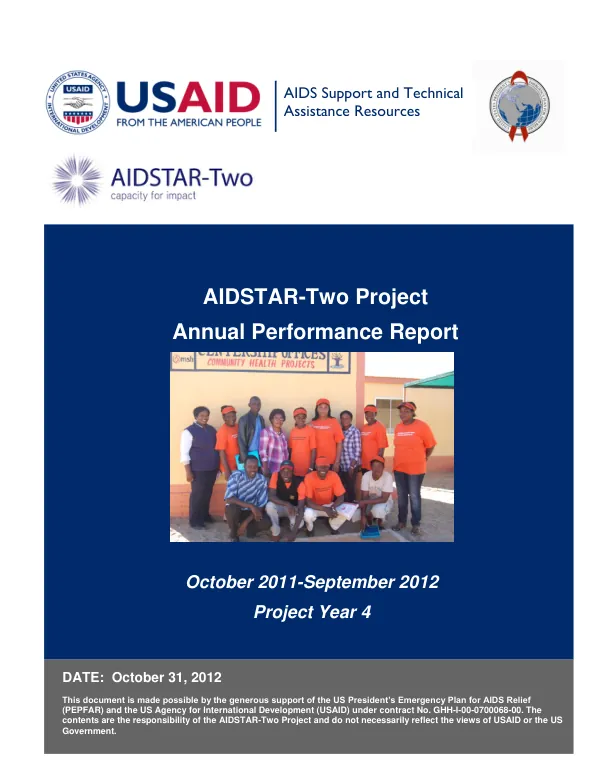
AIDSTAR-Two Annual Performance Report, Project Year 4
The AIDSTAR-Two Project, launched in October 2008, aims to contribute to stronger and more sustainable country-led HIV/AIDS programs, organizations, and networks by offering systematic capacity building and identifying and sharing proven practices of HIV/AIDS organizational capacity building.
2012 · 79 pages
Sign in to readA free account is required to download.
Abstract
The project is led by Management Sciences for Health (MSH) and includes a consortium of organizations, including International HIV/AIDS Alliance, Cardno Emerging Markets USA, Ltd, and Religions for Peace. During Project Year 4 (PY4), which spanned from October 1, 2011 to September 30, 2012, the AIDSTAR-Two Project continued to support local HIV/AIDS implementing organizations in 10 countries, including Honduras, Namibia, Tanzania, Malawi, Morocco, Algeria, Tunisia, Lebanon, the Democratic Republic of the Congo, and Ukraine. Technical assistance was provided to enhance the capacity of these organizations to deliver effective HIV/AIDS programs and services. One of the key highlights of PY4 was the significant increase in visitors to the Capacity Building Knowledge Exchange Network (CBKEN). By the end of the year, CBKEN had 9,674 unique visitors from 165 countries, nearly a two-fold increase in users accessing the site since the end of PY3. Additionally, the OVCSupport.net platform saw a significant increase in users, with 88,777 unique users from 199 countries, an 18% increase in users over PY3. Users also downloaded more than 81,500 documents from the site's library. The AIDSTAR-Two Project also conducted several webinars and workshops on various topics related to HIV/AIDS, including household economic strengthening, early childhood development, maternal mental health, and HIV status disclosure. These events reached a total of 186 participants from around the world. Furthermore, the project convened a one-day consultation on Performance-Based Initiatives (PBI) in conjunction with the USAID-funded HS20/20 project, which resulted in enhanced knowledge and skills for 32 USAID Washington colleagues who provide support to local missions on PBI initiatives. The project also collaborated with the Ho Chi Minh City Provincial AIDS Council to develop a five-year strategic plan for the council's work with men who have sex with men. Additionally, ten health care professionals from Botswana and Kenya were trained on how to develop and implement cervical cancer screening and treatment programs for HIV-positive women in their countries. The AIDSTAR-Two Project's work during PY4 demonstrates its commitment to strengthening national HIV/AIDS programs and organizations through systematic capacity building and the identification and sharing of proven practices. The project's achievements during this period have contributed to the advancement of global treatment, prevention, and care for those living with or affected by HIV/AIDS.