BANK FOR WEST AFRICAN DEVELOPMENT
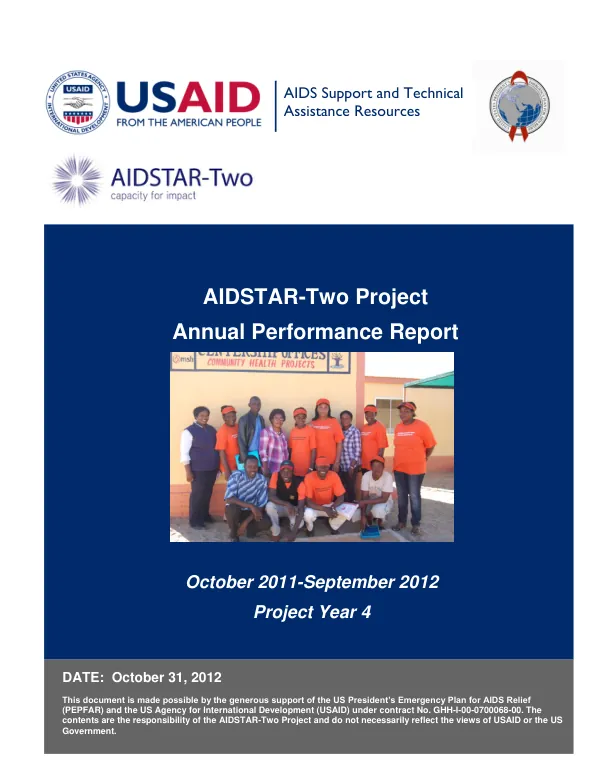
AIDSTAR-Two Semi-Annual Performance Report, Project Year 4
The AIDSTAR-Two project, led by Management Sciences for Health (MSH), aims to provide organizational capacity building support to HIV/AIDS implementing organizations.
2012 · 57 pages
Sign in to readA free account is required to download.
Abstract
The project's mandate is to strengthen management, leadership, governance, and HIV/AIDS technical capabilities of local institutions, including non-governmental organizations, civil society organizations, public sector institutions, and Global Fund country coordinating mechanisms. AIDSTAR-Two's approach contributes directly to two of the four essential dimensions of country ownership: capabilities and institutional and community ownership. The project's activities and results during the first six months of Project Year 4, October 1, 2011-March 30, 2012, are highlighted in this report. During this reporting period, AIDSTAR-Two provided organizational capacity building support in 10 countries, including Honduras, Tanzania, Malawi, the Democratic Republic of the Congo, Tunisia, Morocco, Lebanon, Algeria, Namibia, and Vietnam. The project also provided technical assistance to the PEPFAR's Caribbean Region team and the Africa Bureau. The project launched the OVC Research Newsletter in partnership with the Human Sciences Research Council, which was disseminated to 3,000 recipients. OVCSupport.net had more than 17,800 unique users in this reporting period, an increase of 44% over the previous six months. AIDSTAR-Two also hosted a successful virtual seminar via the LeaderNet platform, focusing on the governance of civil society organizations, attended by 346 participants from 62 countries. The project concluded technical assistance to the Ho Chi Minh City delegation and the Provincial AIDS Council from the Asia Men Who Have Sex with Men (MSM) regional meeting, by conducting a workshop to facilitate the development of a five-year plan addressing the needs of MSM. AIDSTAR-Two also concluded the Virtual Leadership Development Program, launched in the last reporting period for regional teams from the Asia Pacific Leadership Forum. The project sponsored workshops and conferences focused on people who inject drugs and orphans and vulnerable children, reaching hundreds of policy makers and implementers from many countries. These activities demonstrate AIDSTAR-Two's commitment to strengthening country-led HIV/AIDS programs, organizations, and networks. AIDSTAR-Two's work is guided by the principles of country ownership, which emphasizes the importance of local institutions taking ownership of programs and making decisions about their implementation. The project's approach is based on the understanding that local institutions have the capabilities to perform all program management activities, including procurement, and that they should make and own the final decisions and have responsibility for programs. The AIDSTAR-Two project is funded through the Global Health Bureau's Office of HIV/AIDS and is implemented by a consortium of organizations, including International HIV/AIDS Alliance, Cardno Emerging Markets USA, Ltd, Health and Development Africa, Initiatives, Inc, Save the Children, and Religions for Peace. The project's new partner is the Human Sciences Research Council based in Durban, South Africa. AIDSTAR-Two's activities and results during the first six months of Project Year 4 demonstrate the project's commitment to strengthening country-led HIV/AIDS programs, organizations, and networks. The project's approach and achievements highlight its contribution to the global effort to combat HIV/AIDS and support the development of sustainable and effective HIV/AIDS programs.