MANAGEMENT SCIENCES FOR HEALTH
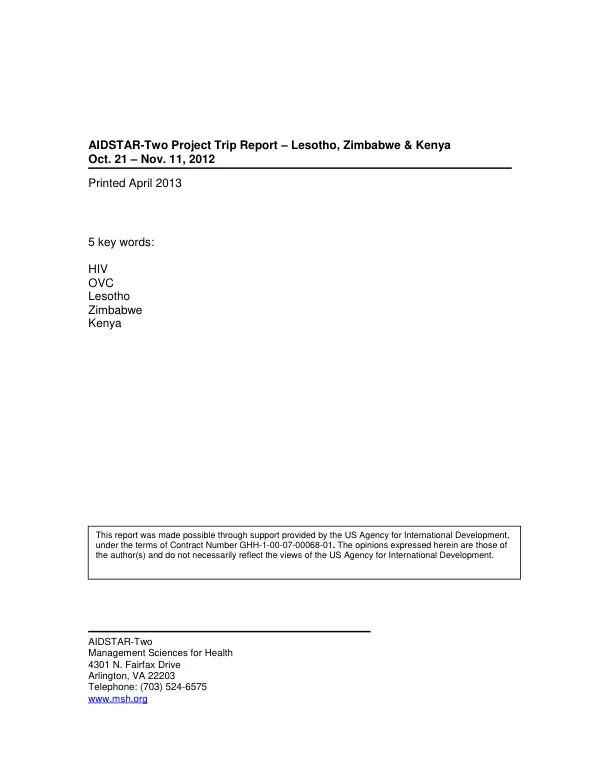
AIDSTAR-Two Project Trip Report – Lesotho, Zimbabwe & Kenya
The AIDSTAR-Two Project Trip Report documents a research trip conducted by Dr.
2012 · 8 pages
Sign in to readA free account is required to download.
Abstract
Valerie Haugen, an independent consultant and researcher, to Lesotho, Zimbabwe, and Kenya from October 21 to November 11, 2012. The trip aimed to gather information from knowledgeable individuals representing a range of organizations and perspectives to inform the development of guidance and tools for USAID Mission personnel in programming for equitable access to education for Orphans and Vulnerable Children (OVC) affected by HIV-AIDS. Dr. Haugen conducted a series of face-to-face key participant interviews with 47 individuals from various organizations, including USAID Washington and missions, partner governments, donor/development partner organizations, local civil society organizations, and beneficiary groups. The interviews focused on country-specific strategies and programming, strengths and issues with current strategies, notable programming or projects, views on USAID mission personnel capabilities and needs, and suggestions for developing guidance and instruments. The trip accomplishments included qualitative data collection and iterative, informal analysis, which revealed consistent themes emerging among interviewees in each country and across countries. These themes included appreciation for the PEPFAR OVC Guidance, issues with definitional and programmatic space, challenges with harmonization, interest in additional products, and awareness of not causing harm. The report highlights the importance of grounded research as part of project implementation or for impact evaluation, the need for rigorous analysis of qualitative data, and the value of collecting relevant documents not available prior to the trip. The trip also generated high levels of interest among those interviewed regarding USAID Washington's next steps and how the results of the fieldwork will be shared. The next steps outlined in the report include rigorous analysis of qualitative data and secondary source documentation for each country and a meta-analysis of the data and findings across each country to arrive at an aggregated set of findings and a set of conclusions and recommendations grounded in evidence. The report will be produced and submitted to USAID by the end of January 2013, and a product determination workshop will be convened by USAID in February 2013 to agree on actual products to be developed. The report also lists key individuals contacted during the trip, including their organization, contact information, and brief notes on interactions with the person. The document includes a description of relevant documents and addendums, which provide additional information and context for the trip and its findings. The AIDSTAR-Two Project Trip Report provides valuable insights into the OVC, HIV-AIDS, and education access nexus in Lesotho, Zimbabwe, and Kenya, and highlights the importance of grounded research, rigorous analysis, and collaboration in addressing the complex challenges faced by OVC. The report's findings and recommendations will inform the development of guidance and tools for USAID Mission personnel and contribute to the improvement of programming for OVC affected by HIV-AIDS. The report's geographic focus is on Lesotho, Zimbabwe, and Kenya, with a specific emphasis on the OVC, HIV-AIDS, and education access nexus in these countries. The report's context is informed by the PEPFAR Guidance for Orphans and Vulnerable Children Programming, which was developed in July 2012 to help improve programming decisions and implementation for OVC in USAID missions. The report's timeframes are October 21 to November 11, 2012, for the research trip, and January 2013 for the production and submission of the report, February 2013 for the product determination workshop, and March 2013 for product development. The report's recommendations and next steps are aimed at continuing and completing the work from the trip, including rigorous analysis of qualitative data, production and submission of the report, product determination workshop, and product development.