MANAGEMENT SCIENCES FOR HEALTH
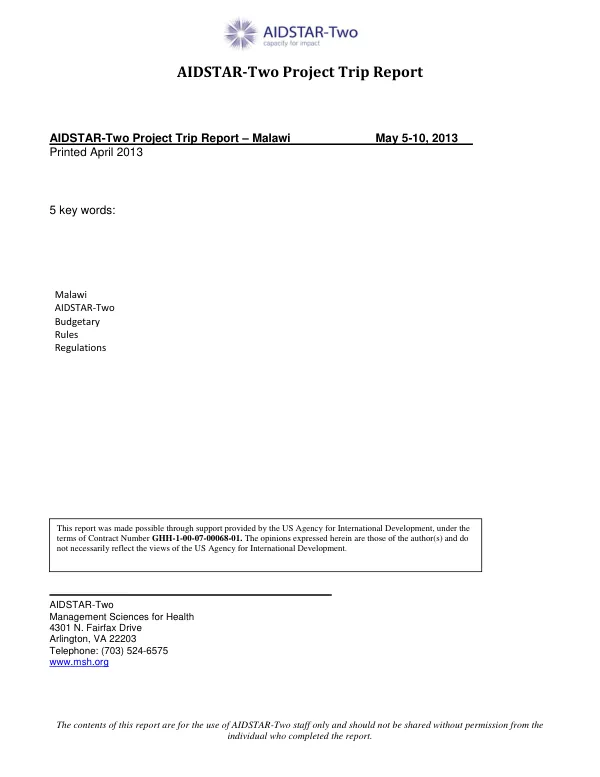
AIDSTAR-Two Project Trip Report – Malawi
The AIDSTAR-Two Project Trip Report documents a trip to Malawi from May 5-10, 2013.
2013 · 5 pages
Sign in to readA free account is required to download.
Abstract
The primary purpose of the trip was to prepare and deliver workshops on US Government Rules and Regulations and Risk Management and Fraud Prevention for executive leadership of 14 local Civil Society Organizations (CSOs) with whom AIDSTAR-Two is working. The workshops aimed to provide CSO leadership with an overview of the USG regulatory framework, help them apply an understanding of USG cost principles, financial management requirements, and agreement requirements to their own operations, and equip them with the ability to complete a risk register for their organizations based on tools introduced during the workshop. The workshops also covered topics such as audit requirements for non-U.S. organizations, mandatory standard provisions, and internal controls related to risk management and fraud prevention. The trip report highlights the major trip accomplishments, which include delivering a one-day workshop on USG Rules and Regulations and a two-day workshop on Risk Management and Fraud Prevention. The specific objectives of these workshops included providing CSO leadership with an overview of the USG regulatory framework, helping them apply an understanding of USG cost principles, financial management requirements, and agreement requirements to their own operations, and equipping them with the ability to complete a risk register for their organizations. The workshops were well-received by the participants, who appreciated the interactive group sessions and the use of case studies to illustrate the rules. The facilitators left ample time for questions and answers, and the participants were able to apply the risk register tool to their own organizations. The AIDSTAR-Two Malawi CSO Capacity Building Project was launched in October 2011 as an initiative to strengthen the technical and managerial capacity of local CSOs in order to enhance the quality and effectiveness of their response to HIV/AIDS in Malawi. The project works with 14 local CSOs providing a range of HIV/AIDS services and/or working in the areas of HIV/AIDS advocacy, and seeks to strengthen their organizational capacity in leadership, management, governance, advocacy, and monitoring and evaluation. The trip report also highlights the background and context of the project, which includes the launch of the project in October 2011 and the delivery of a two-day workshop on financial management for executive leadership of the 14 CSOs in May 2012. The CSOs have taken steps to further develop their financial and administrative capacity, and executive leadership has identified the need to better understand USG rules and regulations, particularly how the USG regulatory framework speaks to strong financial and administrative systems. The trip report concludes by highlighting the major programmatic goals realized, relevant metrics, and stories of impact from the trip. The report provides a detailed account of the workshops, the objectives, and the accomplishments, and highlights the importance of the project in strengthening the technical and managerial capacity of local CSOs in Malawi.