USAID
Memorandum: Foreign Trip Report (AJIj/RSA)
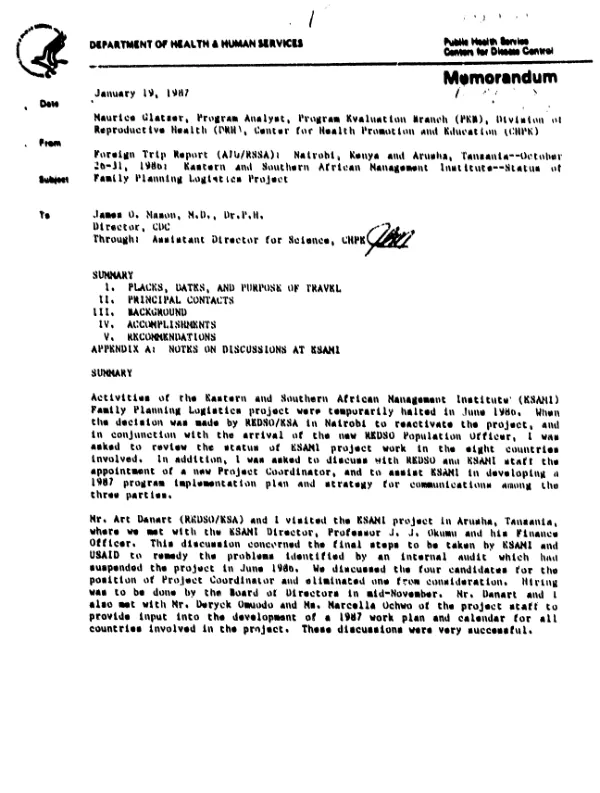
The Family Planning Logistics project of the Eastern and Southern African Management Institute (KSMII) was temporarily halted in June 1987 due to a decision made by the Regional Director's Office (RKDSO) in Nairobi.
10 pages
Sign in to readA free account is required to download.
Abstract
The project was reactivated in conjunction with the arrival of a new RKDSO Population Officer. Maurice Glatzer, a program analyst from the Program Evaluation and Research (PKA) unit, was asked to review the status of the project in eight countries involved. Glatzer visited the KSMII project in Arusha, Tanzania, where he met with the KSMII Director, Professor Jo J. Okiti, and his finance officer. They discussed the final steps to be taken by KSMII and USAID to remedy the problems identified by an internal audit that had suspended the project in June 1987. The discussion also concerned the four candidates for the position of Project Coordinator, with one candidate being eliminated from consideration. Glatzer and Art Danart, the RKDSO/KSA representative, also met with Mr. Deryck Omuodo and Ms. Marcella Muhwo of the project staff to provide input into the development of a 1988 work plan and calendar for all countries involved in the project. These discussions were successful, and Glatzer was able to provide recommendations for the project's future direction. The project's background involved the suspension of the Contraceptive Supply Management project, funded by USAID, pending the results of an audit and a logistics management workshop scheduled for October 1986. Countries expecting to attend the workshop, including Tanzania, Uganda, Swaziland, and Malawi, were informed of the postponement. Glatzer was asked to assist RKDSO in the new startup of the project, including developing a 1988 program implementation plan and communications procedures for the remaining period of the project. He traveled to Nairobi, Kenya, from October 4 to 8, 1987, to review the status of the project with Mr. Art Danart and Ms. N. Wathika of the KSMII staff. The project's principal contacts included Mr. K. O. Anire, Population Officer, and Ms. R. Watthaja, Program Assistant. Other key contacts included Professor J. O. Okiti, Director of KSMII, and Mr. D. Omuodo, Acting Project Coordinator. Glatzer's recommendations for the project's future direction included establishing a new project coordinator and developing a 1988 program implementation plan. He also suggested that RKDSO establish a meeting with the new project coordinator to discuss the project's future direction. The project's implementation plan involved reviewing the status of the project, conducting a midterm evaluation, and developing a 1988 work plan and calendar for all countries involved in the project. Glatzer's recommendations also included establishing a meeting with the new project coordinator to discuss the project's future direction and developing a plan to address the project's logistical challenges. The project's geographic focus was on eight countries in Eastern and Southern Africa, including Tanzania, Uganda, Swaziland, and Malawi. The project's timeframes involved a 1988 program implementation plan and a 1988 work plan and calendar for all countries involved in the project.