RTI INTERNATIONAL
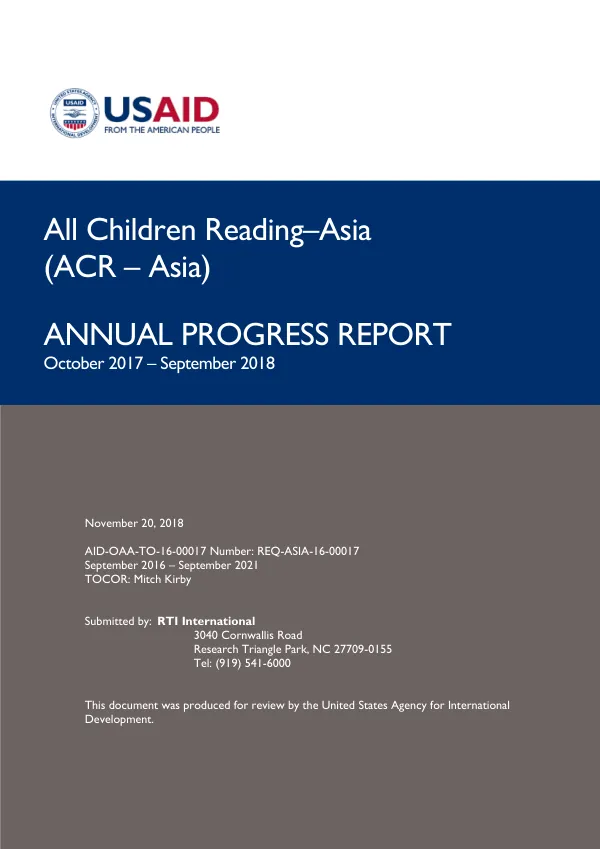
All Children Reading - Asia Annual Progress Report October 2017-September 2018
The All Children Reading–Asia (ACR-Asia) initiative began in September 2016 and is set to conclude in September 2021.
2018 · 61 pages
Sign in to readA free account is required to download.
Abstract
The project aims to improve early grade reading outcomes in lower- and middle-income countries in Asia. RTI International serves as the prime implementing partner for the initiative, which is funded by the United States Agency for International Development (USAID). The ACR-Asia initiative focuses on several key activities, including the development of a research report on investing in early grade reading in lower- and middle-income countries in Asia. The report, titled "Investing in Early Grade Reading in Lower- and Middle-Income Countries in Asia," was disseminated through various events and workshops. Additionally, the initiative involves the adaptation of a gender equality and inclusiveness guide for Asia, as well as the development of recommendations for early childhood education programming in the region. The ACR-Asia initiative also includes the development of early grade reading (EGR) benchmarks and standards research reports. One such report, titled "EGRA Benchmarks and Standards Research Report," was completed in 2018. The report provides a framework for assessing EGR outcomes in Asia. Furthermore, the initiative involves the analysis of EGR assessments in India, as well as the development of the EGR Barometer, a tool used to track EGR outcomes in the region. The ACR-Asia initiative has made significant progress in improving EGR outcomes in Asia. According to the initiative's annual progress report, the number of EGR Barometer Facebook followers increased significantly after ad campaigns were launched. The report also highlights the development of a master trainer program, which aims to improve the capacity of educators to deliver high-quality EGR instruction. The initiative has also made progress in promoting inclusive education in Asia, with a focus on disability screening and support. The ACR-Asia initiative has also provided technical assistance to several countries in the region, including Cambodia and the Philippines. In Cambodia, the initiative has supported the development of a national EGR assessment framework, while in the Philippines, the initiative has provided training and capacity-building support to the Department of Education. The initiative has also conducted a disability screening pilot in the Philippines, which aims to identify and support students with disabilities. Overall, the ACR-Asia initiative has made significant progress in improving EGR outcomes in Asia. The initiative's focus on research, capacity building, and technical assistance has helped to improve the quality of EGR instruction and promote inclusive education in the region.