USAID DEC
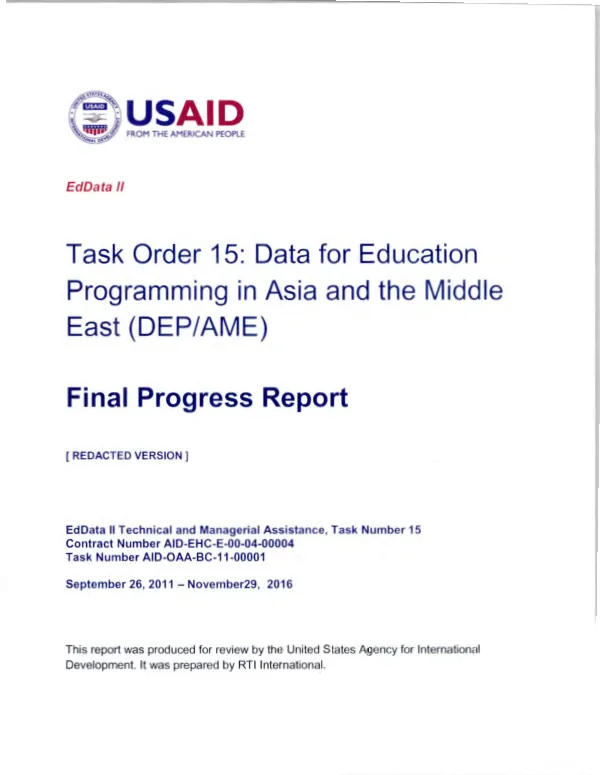
EdData II Task Order 15: Data for Education Programming in Asia and the Middle East (DEP/AME) Final Progress Report
Sign inRTI INTERNATIONAL
EdData II Task Order 15: Data for Education Programming in Asia and the Middle East (DEP/AME) Final Progress Report
EdData II Task Order 15: Data for Education Programming in Asia and the Middle East (DEP/AME) is a final progress report covering the period from September 26, 2011, to November 29, 2016.
2016 · 108 pages
Sign in to readA free account is required to download.
Abstract
The report was prepared by RTI International for the United States Agency for International Development (USAID). The report highlights key accomplishments under four main results. Result 1 focuses on meeting Asia Bureau and missions' data needs related to the AME mission strategy. Key accomplishments include institutional assessments of early grade reading in Bangladesh, Burma, and Cambodia, as well as support to USAID India's performance monitoring of early grade reading programs. Other notable achievements include research on the Indian Institutes of Technology, a skills gap analysis study in the Lower Mekong region, and an early grade reading assessment in Tajikistan. Result 2 emphasizes the expansion of available AME education data and trends. The report highlights education trends analyses for the Middle East and North Africa, Central and South Asia, and East Asia. Topical analyses include early grade reading instruction in Arabic, cost-effectiveness comparisons of early grade reading programs in the MENA region, and a framework for scale-up and sustainability of early grade reading programs. Result 3 focuses on measurement tools for cross-country use. The report highlights the development of a reading improvement modeling tool, the EGRA Barometer, as well as the identification and prioritization of topics needing measurement tools. Phase 1 of the project involved the identification of topics, while Phase 2 focused on the development of the EGRA Barometer. Result 4 emphasizes the strengthening of USAID staff knowledge. The report highlights training needs and preferences surveys of USAID education personnel in Asia and the Middle East regions. Training plans were developed for regional and mission education personnel, and online training on evaluation was provided for mission education staff. Support was also provided to various workshops and conferences, including the 2016 USAID Asia Region Education Workshop. The report also highlights challenges encountered in achieving results, including managing a broad range of goals, countries, and stakeholders. Despite these challenges, the project made significant progress in meeting its objectives and contributing to the improvement of education data and trends in Asia and the Middle East.
Related documents