AGA KHAN FOUNDATION
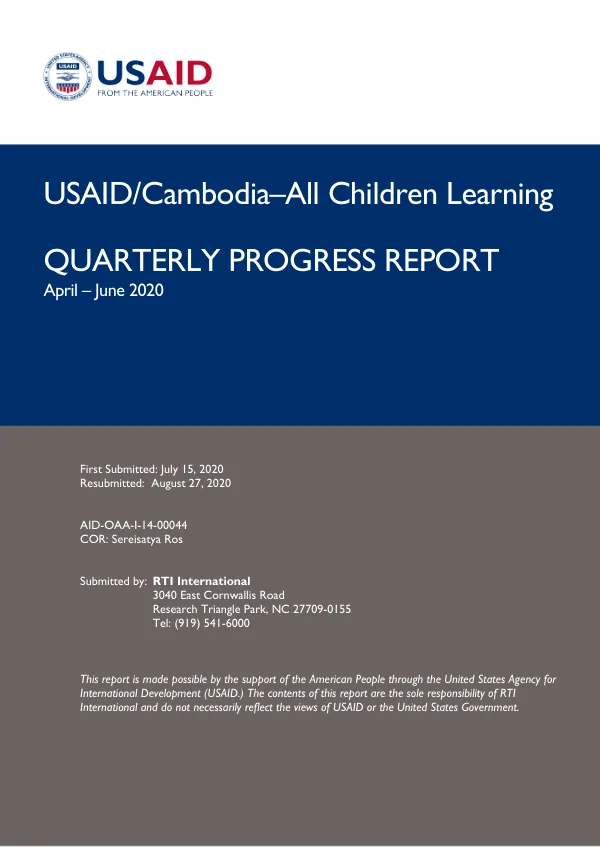
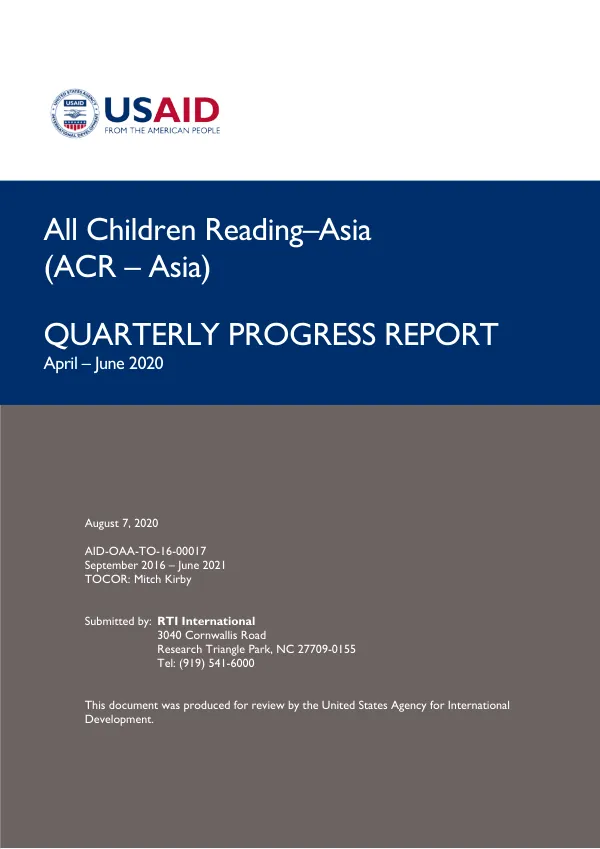
All Children Reading–Asia Quarterly Progress Report April – June 2020
The All Children Reading–Asia (ACR–Asia) task order is a 5-year initiative with an anticipated funding ceiling of $X.
2020 · 48 pages
Sign in to readA free account is required to download.
Abstract
The project aims to improve early grade reading (EGR) skills for 100 million children in Asia, directly contributing to the US Agency for International Development's (USAID's) education goal. ACR–Asia provides technical, logistical, and implementation services to USAID Missions in Asia, countries in the region with limited USAID presence, and the Asia Regional Bureau in Washington, DC. To achieve this goal, ACR–Asia builds capacity and leadership of key education stakeholders from governmental and nongovernmental organizations (NGOs) to implement evidence-based, high-impact EGR programs. The project is in its fourth year of implementation, with a focus on increasing impact, scale, and sustainability of reading outcomes for primary learners (grades 1–5). The ACR–Asia task order has three intermediate results (IRs) and six sub-IRs. IR 1: Leadership and Capacity Building aims to increase the capacity of USAID Mission staff and partners in the education sector, as well as advance education partnerships. IR 2: Evidence and Evaluation focuses on determining the effectiveness of specific reading interventions, increasing the ability of USAID Missions and key education partners to collect, analyze, and use data for decision-making, and disseminating up-to-date knowledge of EGR to target audiences and stakeholders. IR 3: Design and Implementation Support aims to increase the institutional capacity of USAID field missions and partners to design, implement, and take to scale evidence-based, high-impact EGR programs. ACR–Asia has begun implementation of discrete activities that contribute to these results areas, including the Burma Education Sector Assessment, the Sesame Workshop COVID-19 Response Activity, and the Build Out EGR Barometer. The Burma Education Sector Assessment aimed to identify key challenges and opportunities for improving EGR in Burma. The assessment revealed that limited access to education, inadequate teacher training, and a lack of reading materials were major barriers to improving EGR. The Sesame Workshop COVID-19 Response Activity provided support to education systems in the Asia region to address the impact of the pandemic on EGR. The Build Out EGR Barometer is a tool designed to measure the effectiveness of EGR programs in the Asia region. The barometer assesses the quality of EGR programs, including the availability of reading materials, teacher training, and student assessment. The tool is intended to provide a framework for evaluating the impact of EGR programs and identifying areas for improvement. ACR–Asia has also provided technical assistance to the Ministry of Public Education in Uzbekistan to improve EGR outcomes. The project has supported the development of a national EGR strategy, as well as the implementation of evidence-based EGR programs in selected schools. In addition, ACR–Asia has provided support to the Department of Education in the Philippines to improve EGR outcomes, including the development of a national EGR strategy and the implementation of evidence-based EGR programs in selected schools. Overall, ACR–Asia is making progress in achieving its goals, including increasing the capacity of USAID Mission staff and partners, determining the effectiveness of specific reading interventions, and disseminating up-to-date knowledge of EGR to target audiences and stakeholders. However, challenges remain, including limited access to education, inadequate teacher training, and a lack of reading materials.