PAN AMERICAN WORLD HEALTH ORGANIZATION
USP DQI TRIP REPORT
The Amazon Malaria Initiative (AMI) is a multidisciplinary approach to prevent and control malaria in Bolivia, Brazil, Colombia, Ecuador, Guyana, Peru, and Suriname.
2012 · 21 pages
Sign in to readA free account is required to download.
Abstract
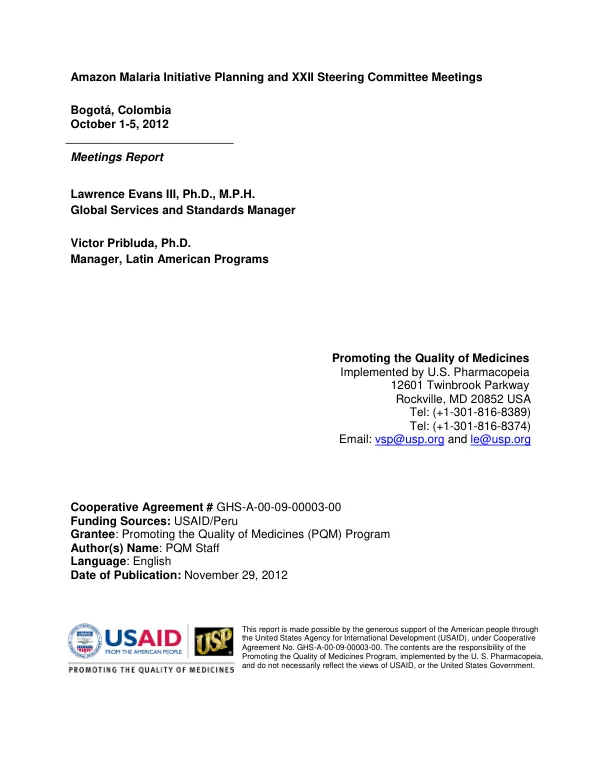
The initiative has been providing technical assistance to the participating countries since 2001, initially through the USP Drug Quality and Information (DQI) program and currently through the Promoting the Quality of Medicines (PQM) program. PQM provides assistance to ensure the availability of good quality medicines and strengthen quality assurance and quality control systems in the participating countries. The initiative has traditionally developed work plans individually, which are subsequently submitted to USAID for comments and approval. However, during the XXI AMI Steering Committee Meeting held in Guatemala in March 2012, a new format was proposed for the work plan that includes not only projected activities for the coming year but also prospective general goals for the following years. The PQM staff traveled to Colombia to attend the AMI/RAVREDA Planning Meeting with in-country partners and the XXII Steering Committee Meeting. The trip was funded by USAID/Peru for the Amazon Malaria Initiative. The meeting highlights include a Partners Meeting on October 1, 2012, where representatives of all international partners participated in a meeting to discuss the format and goals of the Planning Meeting. The AMI/RAVREDA Planning Meeting was held on October 2-4, 2012, and was attended by representatives from all attending countries, including Belize, Bolivia, Brazil, Colombia, Ecuador, Guyana, Honduras, Nicaragua, Panama, Peru, and Suriname. PQM staff discussed the one-year planning and the three-year prospective goals with the representatives, and all international partners identified regional activities to be pursued. The countries submitted one- and three-year plans, which will be reviewed by international partners within their own area of technical support. The XXII AMI Semi-annual Steering Committee Meeting was held on October 5, 2012, and was attended by the international partners and representatives from Belize, Brazil, Colombia, and Ecuador. The meeting provided input on the results of the preceding days' meetings, which were considered by all as very useful and productive. PQM and other partners presented financial updates, the status of last year's activities, and future plans. The group discussed AMI's accomplishments and the need to maintain funding beyond 2015, so as to provide baseline assistance to the countries until their malaria control and prevention programs are self-sustaining. The participating countries have traditionally developed their work plans individually, but the new format proposed during the XXI AMI Steering Committee Meeting includes not only projected activities for the coming year but also prospective general goals for the following years. This new format aims to ensure that the remaining gaps in the various lines of intervention are properly addressed in a timely manner. The AMI/RAVREDA Planning Meeting and the XXII AMI Semi-annual Steering Committee Meeting were attended by representatives from all attending countries, including Belize, Bolivia, Brazil, Colombia, Ecuador, Guyana, Honduras, Nicaragua, Panama, Peru, and Suriname. The meetings provided a platform for the countries to discuss their one- and three-year plans, which will be reviewed by international partners within their own area of technical support. The PQM program provides assistance to ensure the availability of good quality medicines and strengthen quality assurance and quality control systems in the participating countries. The program has been providing technical assistance to the Amazon Malaria Initiative since 2001, initially through the USP Drug Quality and Information (DQI) program and currently through the Promoting the Quality of Medicines (PQM) program.