USAID DEC
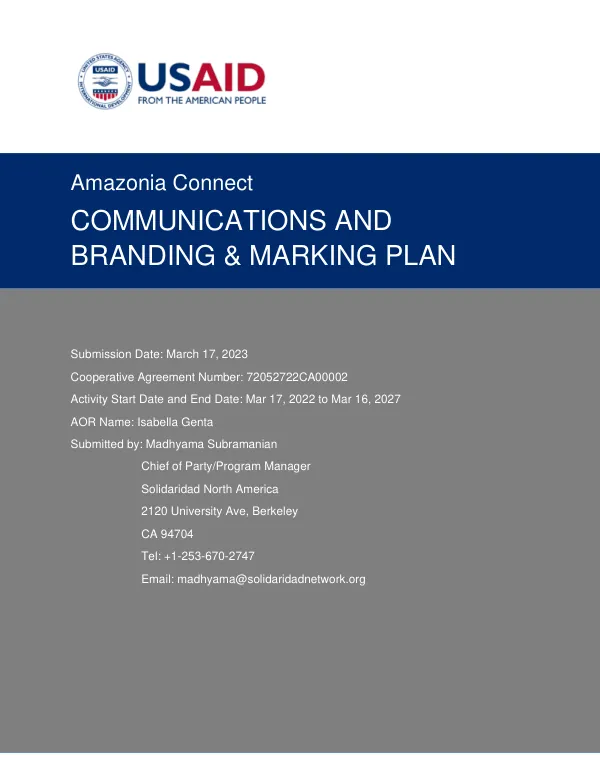
Amazonia Connect Communications and Branding Plan
Amazonia Connect is a five-year activity implemented by Solidaridad, in partnership with Earth Innovation Institute (EII), National Wildlife Federation (NWF), and the University of Wisconsin–Madison (UW) between 2022 and 2027.
2023 · 95 pages
Sign in to readA free account is required to download.
Abstract
The activity aims to reduce commodity-driven deforestation and improve biodiversity conservation in key Amazon jurisdictions. The project will be implemented in the Amazon biome in Brazil (Mato Grosso and Pará), Colombia (Caquetá and Meta), and Peru (San Martin and Ucayali) with a budget of US$ 16,367,835. The main strategy of the project is to implement actions that support transformation of value chains, which is also a requirement for new regulation, such as the EU Due Diligence for Deforestation-Free imports. The project implementation strategy serves as a guide for all project partners and will be reviewed and updated annually for adaptive management. Key results, assumptions, indicators, and learning questions were developed in a collaborative manner within the consortium to assure coherence. Amazonia Connect seeks to promote adoption of Low Carbon Agriculture (LCA) and Deforestation-Free Production (DFP) models by producers in key Amazon jurisdictions. The project also aims to promote adoption of monitoring systems by companies to enable deforestation-free sourcing and biodiversity monitoring. Additionally, Amazonia Connect seeks to unlock finance and incentives for producers to enable the transition to LCA and DFP models, in conjunction with jurisdictional and private sector mechanisms. The project also aims to turn research into actionable knowledge for policymakers, companies, and multi-stakeholder platforms to scale the project’s impact in the region. The project has four Objectives and the related Pathways, which are listed below. The activities proposed in this communications plan are linked to this framework. Objective 1 focuses on scaling Low Carbon Agriculture (LCA)/ Deforestation-Free Production (DFP) and sourcing models in key Amazon jurisdictions. Objective 2 aims to promote full supply chain monitoring systems used by companies for deforestation-free sourcing and biodiversity conservation. Objective 3 seeks to unlock finance and incentives to accelerate LCA and Deforestation-Free Production. Objective 4 aims to turn research into actionable knowledge for supply chain stakeholders to reduce deforestation and improve biodiversity conservation. The project will work in coffee, livestock (beef and dairy), and oil palm value chains in Brazil, Colombia, and Peru, in regions with the highest commodity-driven deforestation, greenhouse gas (GHG) emissions, and biodiversity impact. By harmonizing and scaling successfully implemented approaches, Amazonia Connect will reduce deforestation driven by unsustainable commodity production in the Amazon, while conserving forests and biodiversity, improving carbon balance in production, and overall human wellbeing. The project's communications plan will be updated every year based on the project's strategy and annual work plan and insights gathered from annual Pause and Reflect Sessions. The plan will be implemented by a project communications team, which will be responsible for coordinating and managing all project communications. The team will work closely with project partners, including EII, NWF, and UW, to ensure that all project communications are aligned with the project's objectives and strategy. The project's communications channels will include social media, email, and print media. The project will also use various communication products, including press releases, newsletters, and reports, to disseminate information to stakeholders. The project's communications plan will also include guidelines for media engagement and management, including press releases, media response guidelines, and crisis communications. The project's branding and marking plan will also be an essential component of the project's communications strategy. The plan will outline the project's brand identity, including its logo, color scheme, and typography. The plan will also provide guidelines for the use of the project's brand identity in all project communications. Overall, Amazonia Connect is a comprehensive project that aims to reduce commodity-driven deforestation and improve biodiversity conservation in key Amazon jurisdictions. The project's communications plan will play a critical role in achieving the project's objectives and will be essential in disseminating information to stakeholders and promoting the project's brand identity.