LA COORDINADORA INDÍGENAS DE LAS ORGANIZACIONES INDÍGENAS DE LA CUENCA AMAZÓNICA
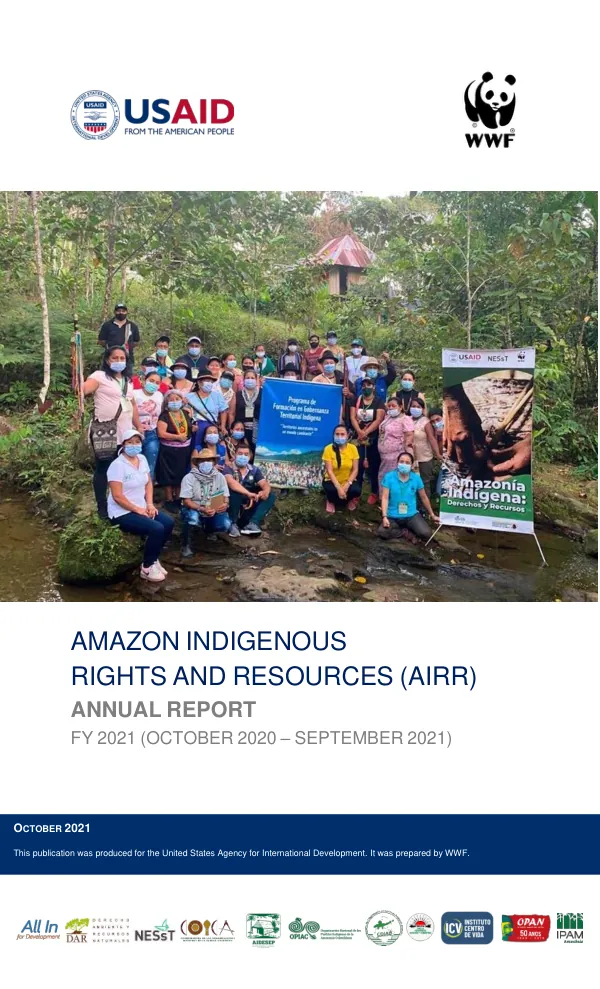
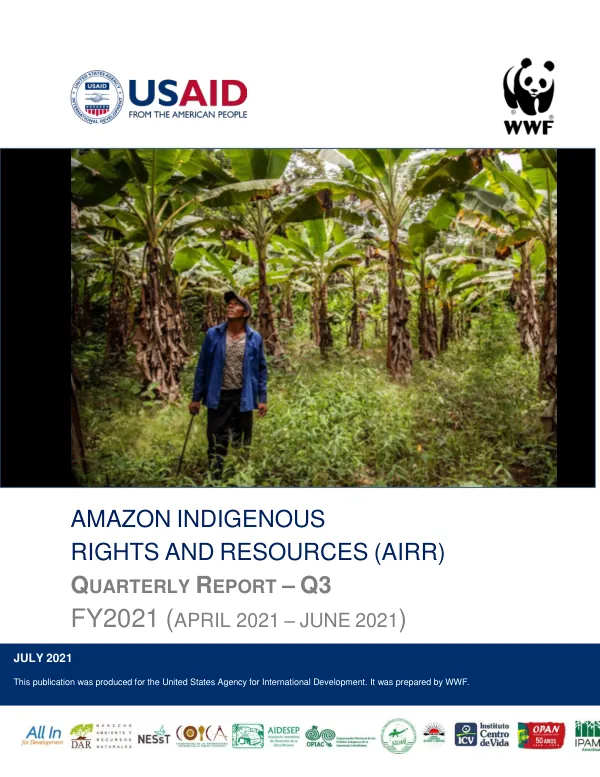
Amazon Indigenous Rights and Resources (AIRR) Quarterly Report – Q3 FY2021
The Amazon Indigenous Rights and Resources (AIRR) project aims to improve participation of Indigenous Peoples (IP) in the sustainable economic development of the Amazon, ultimately leading to the conservation of biodiversity and reduced emissions from forest loss.
2021 · 39 pages
Sign in to readA free account is required to download.
Abstract
The project contributes to the Amazon Regional Environment Program's (AREP) goal to reduce negative impacts of large-scale infrastructure projects, extractive activities, and climate change on Amazon forests and water resources. The project is part of USAID's Biodiversity Policy, which aims to conserve biodiversity through sustainable development, recognizing that human well-being and progress depend on healthy ecosystems. One of the project's premises is that advances in sustainable development are only possible if biodiversity and its regional guardians, the Indigenous Peoples of the Amazon, are valued and cared for. The project has two objectives: Indigenous rights and economic interests incorporated into public and private sector development planning; and Indigenous enterprises equitably and sustainably scaled to local, regional, and global markets. The project is implemented under WWF's leadership in partnership with All in for Development, NESsT, DAR, COICA, four national indigenous organizations (COIAB - Brazil, OPIAC - Colombia, CONFENIAE - Ecuador, and AIDESEP - Peru), and the participation of at least eight subnational Indigenous Peoples organizations (IPOs). The main progress toward achieving Objective 1 was to enable indigenous partners to advocate for their rights and economic interests. In Colombia, the methodology and curriculum for the third cohort of the Capacity-Building Program on Indigenous Territorial Governance (PFGTI) were finalized, scheduled to begin in Q4. In Peru, AIDESEP completed four courses of its first diploma program on Indigenous Governance, Advocacy, and Political Communications at the School for Indigenous Governance and Amazonian Development (EGIDA), strengthening the capacities of 30 leaders. AIDESEP also awarded four grants for research on governance to subnational IPOs whose students are actively participating in EGIDA's diploma program. Finally, AIDESEP's Amazon Woman Indigenous Fund (FIMA) awarded scholarships to its first five winners in June. To achieve an informed decision-making process around infrastructure projects and extractive activities that affect indigenous territories, COICA developed a proposal to link its Early Warning and Rapid Response Systems (SAT-RR) for threats to IP with national monitoring systems, aiming to integrate local and regional monitoring. In Brazil, the Protection and Surveillance Plan for the Apiaká do Pontal and Isolados Indigenous Territory has been implemented, and thematic maps of external pressures on the territory have been developed. The project's progress during Q3 of FY 2021 demonstrates the commitment of its partners to advancing the rights and economic interests of Indigenous Peoples in the Amazon region. The project's implementation is ongoing, with various activities and initiatives underway to achieve its objectives. The Capacity-Building Program on Indigenous Territorial Governance (PFGTI) is scheduled to begin in Q4, and the School for Indigenous Governance and Amazonian Development (EGIDA) is continuing to strengthen the capacities of Indigenous leaders. The project's partners are also working to develop and implement effective monitoring systems to track the impacts of infrastructure projects and extractive activities on indigenous territories. Overall, the AIRR project is making significant progress toward its objectives, and its continued implementation is expected to have a positive impact on the lives of Indigenous Peoples in the Amazon region.
Related documents