USAID DEC
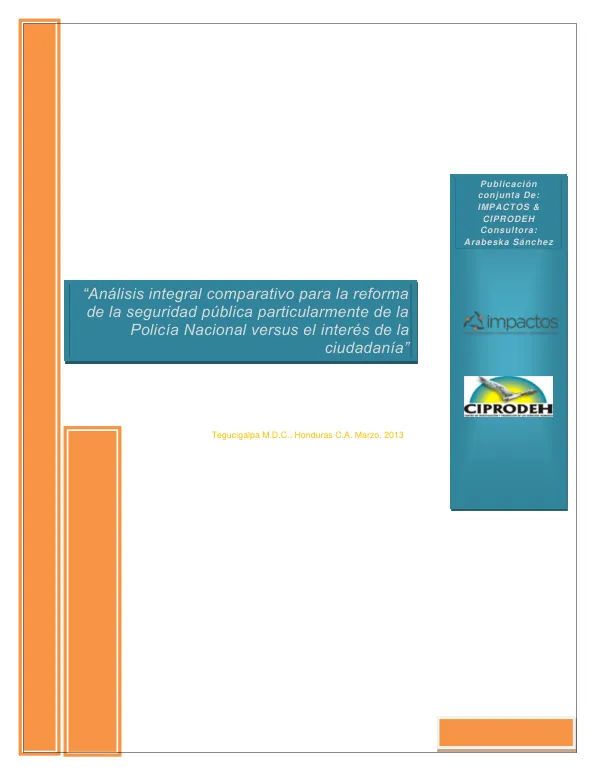
Análisis integral comparativo para la reforma de la seguridad pública particularmente de la Policía Nacional versus el interés de la ciudadanía
Sign inUSAID DEC
Análisis integral comparativo para la reforma de la seguridad pública particularmente de la Policía Nacional versus el interés de la ciudadanía
The crisis of security in Honduras is characterized by high levels of violence, increasing criminality, institutional contamination of the Police National, and high levels of impunity.
2013 · 70 pages
Sign in to readA free account is required to download.
Abstract
According to the University Observatory of Violence, between 2004 and 2012, 41,105 Hondurans lost their lives in violent scenarios, with 31,659 deaths caused by firearm discharges, representing 77% of the total violence. Additionally, 2,851 women died in homicides and femicides, and 35,883 men died, mostly young people between 16 and 30 years old. The increasing criminality is evident in the data from the National Investigation Directorate, which reports 1,114,016 denunciations of various crimes between 1995 and 2012, with the last three years showing the highest registration with 261,099 denunciations, representing a quarter of the total reported. The period of President Manuel Zelaya Rosales and Roberto Michelletti Baín (2006-2009) reported 323,030 denunciations, representing the highest percentage of 29%. The current government of Porfirio Lobo Sosa has registered 248,322 denunciations, representing 22% of the total, which could indicate a growing trend. The institutional contamination of the Police National is also a significant issue, as revealed by the public exposure of links between police members and organized crime groups. The government has launched a series of events aimed at reforming the security public sector, including the establishment of a Commission of Reform to the Security Public (CRSP) through Decree 04-2012. The CRSP has begun to channel proposals for reforming this sector, which is crucial for peace and development. The Society Civil and academia have also made efforts to support the CRSP in its management, with the Centro de Investigación y Promoción de los Derechos Humanos (CIPRODEH) conducting research to respond to the question of whether there is a correspondence between the citizen's interest in reforming the security public sector in Honduras and the State's response through the CRSP's proposal. The research aims to investigate the following questions: (1) Does there exist a correspondence between the citizen's interest in reforming the security public sector in Honduras and the State's response through the CRSP's proposal? (2) What are the main external proposals made between 2012 and 2013 to the State of Honduras in its process of reforming the security public sector? (3) What are the proposals emanating from the CRSP? The research will analyze the CRSP's proposal and compare it with the citizen's interest in reforming the security public sector in Honduras. It will also examine the main external proposals made to the State of Honduras and the proposals emanating from the CRSP. The research aims to provide a comprehensive understanding of the security public sector in Honduras and to inform the reform process. The Commission of Reform to the Security Public (CRSP) was established through Decree 04-2012, with the aim of reforming the security public sector in Honduras. The CRSP has begun to channel proposals for reforming this sector, which is crucial for peace and development. The Society Civil and academia have also made efforts to support the CRSP in its management, with the Centro de Investigación y Promoción de los Derechos Humanos (CIPRODEH) conducting research to respond to the question of whether there is a correspondence between the citizen's interest in reforming the security public sector in Honduras and the State's response through the CRSP's proposal. The research methodology will involve a qualitative and quantitative analysis of the CRSP's proposal and the citizen's interest in reforming the security public sector in Honduras. The research will also involve a comparative analysis of the main external proposals made to the State of Honduras and the proposals emanating from the CRSP. The research aims to provide a comprehensive understanding of the security public sector in Honduras and to inform the reform process. The research findings will be presented in a report that will provide a comprehensive understanding of the security public sector in Honduras and the reform process. The report will also provide recommendations for the CRSP and the State of Honduras on how to