USAID DEC
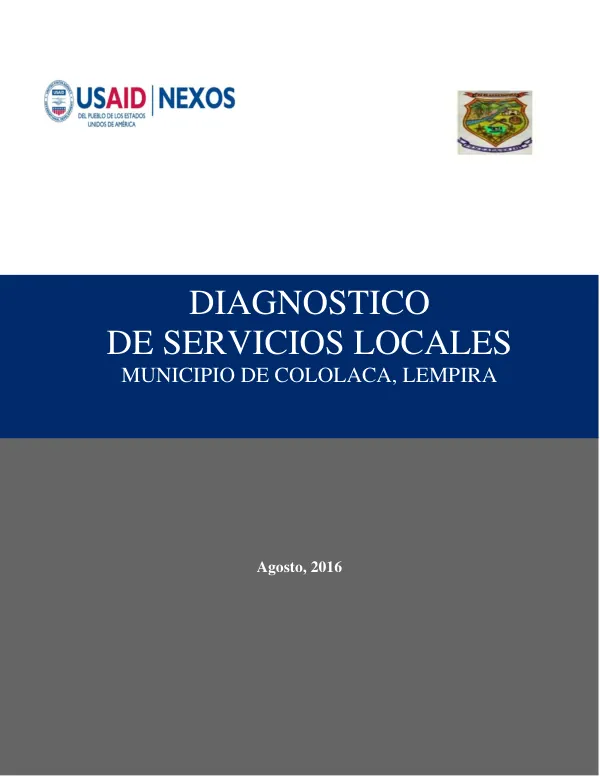
Diagnóstico Municipal en Servicios Locales, Cololaca, Lempira, Honduras, C.A. Agosto 2016
Sign inUSAID DEC
Diagnóstico Municipal en Servicios Locales, Cololaca, Lempira, Honduras, C.A. Agosto 2016
The municipality of Cololaca, Lempira, Honduras, is the focus of a diagnostic study on local services.
2016 · 148 pages
Sign in to readA free account is required to download.
Abstract
The study aims to evaluate the situation of local services, including health, education, water, sanitation, and roads, in the municipality. The study was conducted with the support of the USAID/NEXOS program. The municipal corporation of Cololaca Lempira is composed of the mayor, vice mayor, and five council members. The corporation meets twice a month to discuss municipal affairs. The study found that the relationships between the municipal corporation and civil society are effective, with collaboration in various development processes, open town hall meetings, and community participation in project execution. The municipal corporation has established various planning instruments, including the budget, investment plan, operational plan, and arbitration plan. However, the recaudation of municipal income represents only 4% of total income, and the municipality has a high dependence on central government transfers, which can lead to imbalances in the budget. The study found that the municipal corporation invests significantly in the provision of public services, with a total investment of 17.7 million Lempiras between 2012 and 2016. The service of roads is the largest area of investment, accounting for 42% of total investment. However, the investment in programs for the prevention of violence against women represents only 2.5% of total expenditure. The main providers of public services in the municipality are the MANCOSOL, water and sanitation juntas, and the secretaries of health and education. The service of health is managed by the MANCOSOL, which provides coverage to 9,401 inhabitants with one community health center, one urban health center, and one family health center. The service of water potable is provided by a water administration board, with a coverage of 93.61% in the urban area and 85.92% in the rural area. However, there is no service of sanitation in the municipal capital, and the disposal of excreta in the rural area is carried out through sanitary latrines. The study also found that the municipal corporation does not provide the service of urban waste collection, transportation, and disposal. The educational infrastructure in the municipality consists of 29 educational centers, including three pre-school centers, 25 primary schools, and one technical community institute. The municipality of Cololaca has a population of 71.66% in the productive age, which generates opportunities for development and employment. The municipality has a competitive advantage due to its border with El Salvador, which can be used to promote commercialization channels and the development of local structures, such as the Women's Network. The study concludes that the municipal corporation of Cololaca Lempira has a significant role to play in the provision of public services, but it faces challenges related to budget imbalances, dependence on central government transfers, and limited investment in programs for the prevention of violence against women. The study recommends that the municipal corporation should prioritize the provision of public services, particularly in the areas of health, education, and water, and should seek to reduce its dependence on central government transfers.