USAID DEC
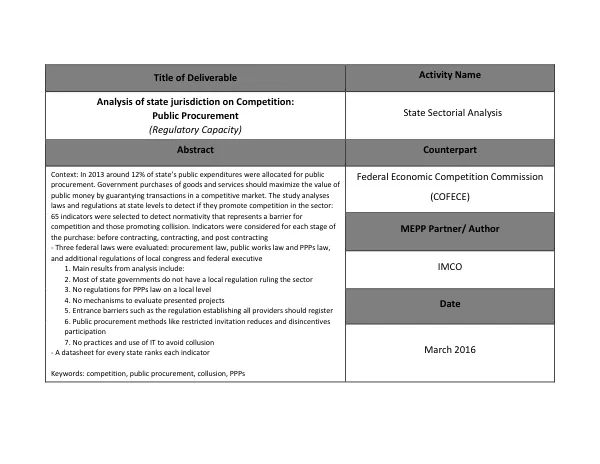
Analysis of state jurisdiction on Competition: Public Procurement (Regulatory Capacity) State Sectorial Analysis
Sign inUSAID DEC
Analysis of state jurisdiction on Competition: Public Procurement (Regulatory Capacity) State Sectorial Analysis
The study on state jurisdiction on competition in public procurement, conducted by the Instituto Mexicano para la Competitividad (IMCO), aimed to analyze the laws and regulations at the state level to detect if they promote competition in the sector.
2016 · 449 pages
Sign in to readA free account is required to download.
Abstract
The study evaluated 65 indicators to determine the normativity that represents a barrier for competition and those promoting collision. The indicators were considered for each stage of the purchase: before contracting, contracting, and post-contracting. The study found that most state governments do not have a local regulation ruling the sector, and no regulations for Public-Private Partnerships (PPPs) law on a local level. Additionally, no mechanisms to evaluate presented projects were found, and entrance barriers such as the regulation establishing all providers should register were identified. Public procurement methods like restricted invitation reduce and disincentivize participation, and no practices and use of IT to avoid collusion were found. The study also found that the majority of state governments do not have a local regulation ruling the sector, and no regulations for PPPs law on a local level. This lack of regulation creates an environment where competition is limited, and collusion can occur. The study also identified that the use of restricted invitation methods in public procurement reduces and disincentivizes participation, which can lead to a lack of competition. The study's methodology involved the construction of 65 indicators to identify the normativity that reduces or limits the level of competition within the procedures, as well as those that enable collusion between competitors. The indicators were applied to each stage of the purchase: before contracting, contracting, and post-contracting. The study's findings have significant implications for the promotion of competition in public procurement. The lack of regulation and the use of restricted invitation methods create an environment where competition is limited, and collusion can occur. The study's recommendations aim to promote competition in public procurement by establishing clear regulations and procedures that ensure transparency and fairness. The study's methodology was designed to analyze the normativity that rige las contrataciones públicas at the state level. The study's findings have significant implications for the promotion of competition in public procurement. The lack of regulation and the use of restricted invitation methods create an environment where competition is limited, and collusion can occur. The study's recommendations aim to promote competition in public procurement by establishing clear regulations and procedures that ensure transparency and fairness. The study's findings have significant implications for the promotion of competition in public procurement, and its recommendations aim to promote a more competitive and transparent environment.