USAID DEC
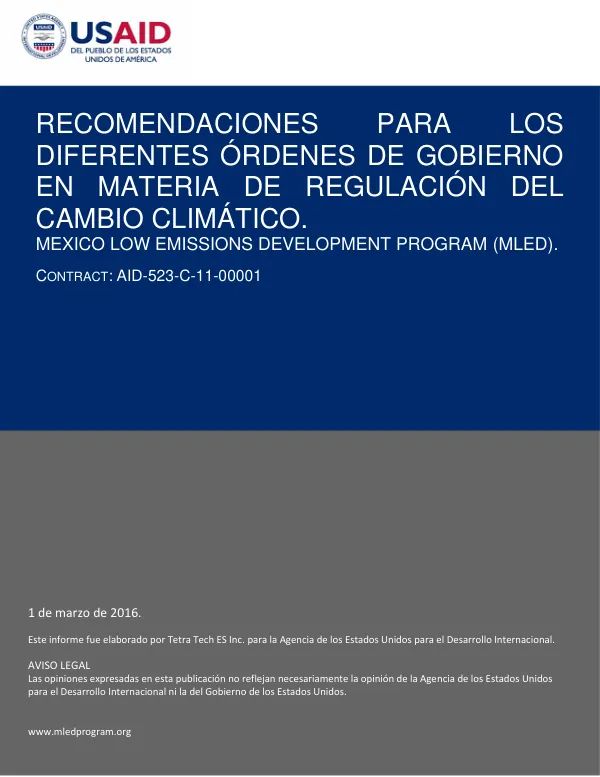
Analysis of state jurisdiction on Competition: Agriculture (Regulatory Capacity)
The agricultural sector in Mexico is a significant economic activity, representing the primary source of income for rural areas.
2016 · 173 pages
Sign in to readA free account is required to download.
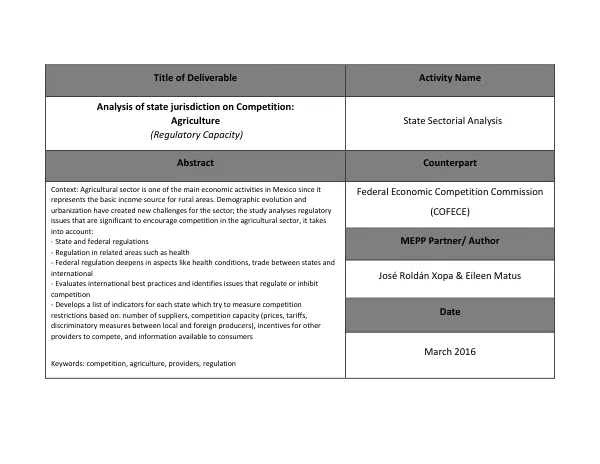
Abstract
The sector is composed of the agricultural and livestock industries, which have a substantial impact on the rural economy. However, demographic evolution and urbanization have created new challenges for the sector, necessitating a reevaluation of regulatory issues to encourage competition. State and federal regulations play a crucial role in shaping the agricultural sector. Federal laws, such as the Ley de Organizaciones Ganaderas and the Ley sobre Cámaras Agrícolas, establish rules for the sector, while state laws and regulations provide additional guidance. The Ley Federal de Sanidad Animal and the Ley Federal de Sanidad Vegetal regulate health-related aspects, and the Ley Federal de Variedades Vegetales governs the production and trade of seeds. The relationship between federal and state regulations is complex, with federal laws serving as a framework for state regulations. The Ley Federal de Variedades Vegetales, the Ley del Desarrollo Sustentable de la Caña de Azúcar, and the Ley Federal de Producción, Certificación y Comercio de Semillas are examples of federal laws that regulate specific aspects of the agricultural sector. State laws, such as those related to health and trade, also play a significant role in shaping the sector. The methodology used to evaluate the impact of regulations on competition in the agricultural sector is based on international best practices, particularly the OECD's Tools for Competition Evaluation. The methodology involves a four-stage process: (1) a general methodology is designed to evaluate the impact of regulations on competition, (2) a list of verification indicators is created to measure restrictions on competition, (3) the indicators are applied to each sector, and (4) the results are evaluated to determine the level of competition. The indicators used to measure restrictions on competition are divided into four themes: (1) number of producers, (2) capacity of competition, (3) incentives for providers to compete, and (4) information available to consumers. Each theme has several subtopics, and the indicators are designed to determine whether a regulation is pro-competitive, neutral, or anti-competitive. The evaluation of the agricultural sector in Mexico reveals that state and federal regulations have a significant impact on competition. The study identifies areas where regulations restrict competition, such as the number of producers, capacity of competition, and incentives for providers to compete. The study also highlights the importance of information available to consumers in promoting competition. The results of the study provide a comprehensive understanding of the regulatory framework governing the agricultural sector in Mexico. The study's findings can inform policy decisions aimed at promoting competition and improving the sector's performance. By analyzing the impact of regulations on competition, the study contributes to the development of a more competitive and efficient agricultural sector in Mexico.