ACADEMY FOR EDUCATIONAL DEVELOPMENT, INC. (AED)
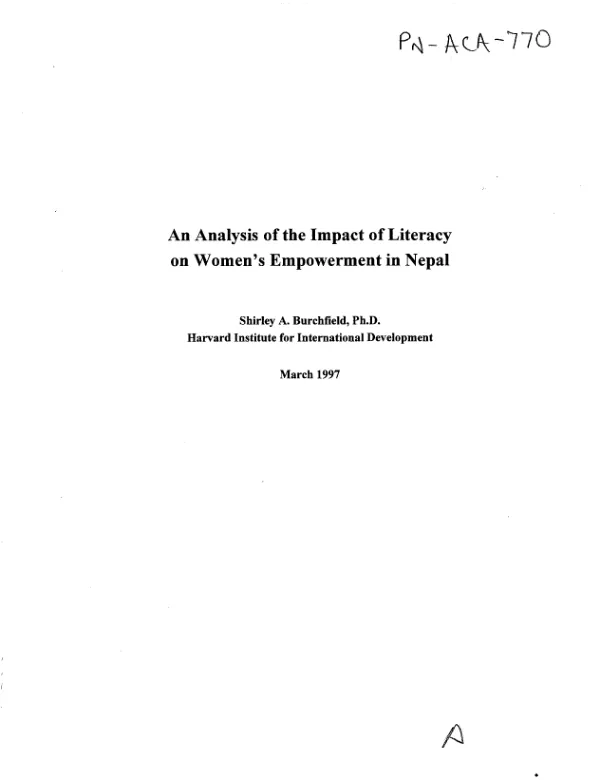
Analysis of the impact of literacy on women"s empowerment in Nepal
This study examines the impact on empowering Nepalese women of two types of literacy programs -- a 6-month basic literacy course and a combined 6-month basic course/3-month post-literacy course.
Burchfield, Shirley A. · 1997
Sign in to readA free account is required to download.
Abstract
The relative cost-efficiency of the two programs is also assessed. Results include the following. (1) A year after completing the courses, the majority of women had retained skills in reading, writing, and mathematics and continued to use them daily. (2) Those who had completed courses, especially post-literacy training, reported increased confidence in several areas, including stating their opinions to their families and the community, as well as participating in decisions about family size and child spacing. For the first time, women were able to consider the possibility of being on the Village Development Council. (3) The survey supports previous findings of a strong correlation between women"s literacy and increased level of interest in the education of their children. (4) Evidence regarding cost-effectiveness was mixed. If the program"s goal is to provide basic skills to the largest number of women at the least cost, the basic literacy course may be considered more cost effective. If the primary interest is to build leadership as well as literacy skills, then substantial benefits can result from providing literacy training for an additional 3 months. (5) Finally, the study has a direct bearing on USAID/Nepal"s interrelated strategic objectives in agriculture, health, and women"s empowerment. Initiating programs in agriculture or health in villages where there are already groups of literate and highly motivated women may help maximize the return on USAID investments.
![Breaking barriers, building bridges : a case study of USAID/Nepal"s SO3 [strategic objective no. 3] women"s empowerment program](https://covers.devme.ai/gen/59559.webp)