USAID
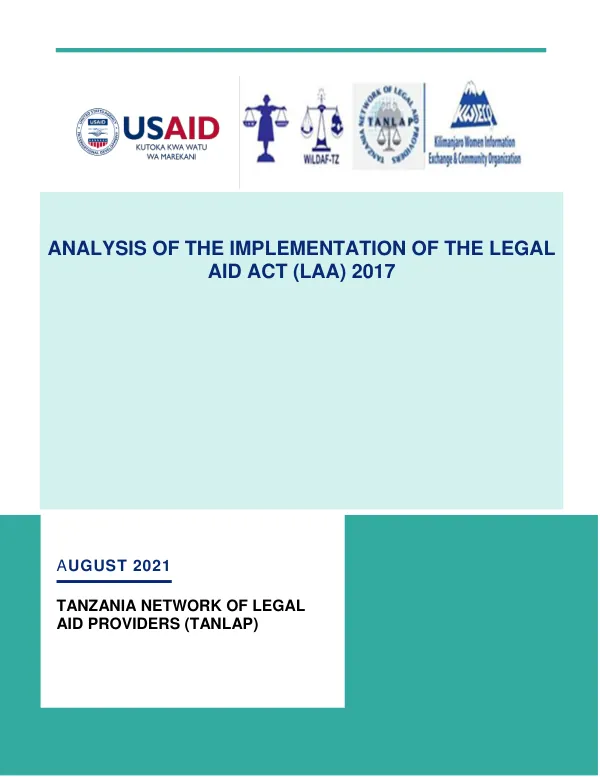
Analysis of the Implementation of the Legal Aid Act (LAA) 2017 in Tanzania
The Legal Aid Act (LAA) 2017 in Tanzania was enacted to improve access to justice, particularly for marginalized groups such as women and young girls.
2021 · 36 pages
Sign in to readA free account is required to download.
Abstract
The Act established the Office of the Registrar, which is responsible for overseeing the provision of legal aid services. Paralegals were also introduced to provide legal assistance to individuals who cannot afford legal representation. The LAA aimed to address the challenges faced by the legal aid system in Tanzania before its enactment. These challenges included limited access to justice, inadequate funding, and a shortage of trained legal professionals. The Act introduced opportunities for legal aid providers, including the establishment of the Legal Services Fund (LSF) to support the provision of legal aid services. The Tanzania Network of Legal Aid Providers (TANLAP) conducted an analysis of the implementation of the LAA, focusing on access to justice in Tanzania. The study examined the formal justice system, including the role of the Office of the Registrar and the provision of legal aid services. It also looked at informal structures for providing legal aid, such as community-based organizations and faith-based organizations. The study found that the LAA has improved access to justice in Tanzania, particularly for marginalized groups. The number of reported cases has increased, and the types of cases reported have diversified. The study also identified key challenges associated with the implementation of the LAA, including inadequate funding, limited resources, and a shortage of trained legal professionals. TANLAP recommends that the government and other stakeholders engage in a collaborative effort to address the challenges associated with the implementation of the LAA. This includes increasing funding for the provision of legal aid services, providing training for legal professionals, and strengthening the capacity of paralegals to provide legal assistance. The study also highlights the importance of community-based initiatives in promoting access to justice in Tanzania. Community-based organizations and faith-based organizations have played a crucial role in providing legal aid services to marginalized groups. The study recommends that these initiatives be supported and strengthened to ensure that access to justice is improved in Tanzania. The analysis was conducted with the support of USAID Tanzania under the Mwanamke Imara Project, which aims to promote the empowerment of women and girls in Tanzania. The study provides valuable insights into the implementation of the LAA and highlights the importance of collaborative efforts to improve access to justice in Tanzania. The study's findings and recommendations are relevant to the achievement of the Sustainable Development Goals (SDGs), particularly Goal 4 (quality education), Goal 5 (gender equality), and Goal 17 (partnerships for the goals). The study demonstrates the importance of access to justice in promoting human rights and reducing inequality in Tanzania.