USAID
Women's Political Participation and Leadership Assessment: Tanzania
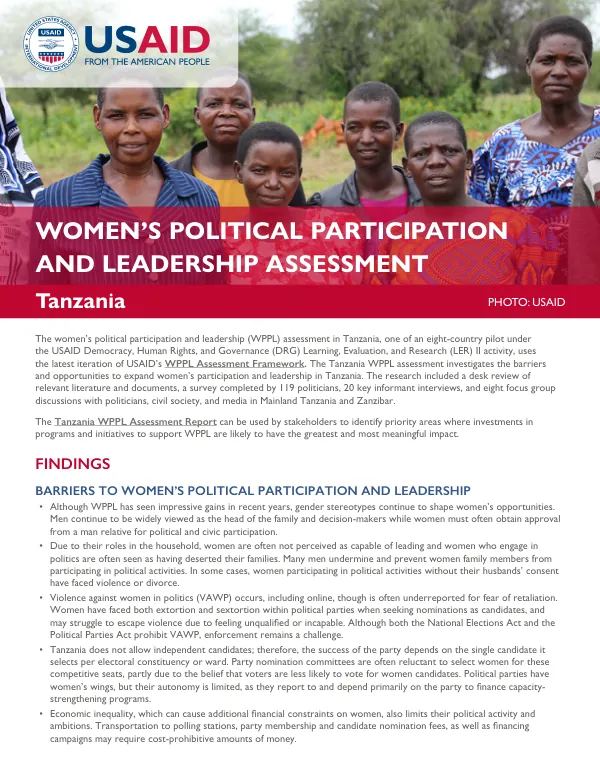
Women's political participation and leadership in Tanzania have seen significant gains in recent years, but persistent barriers and opportunities remain.
2024 · 2 pages
Sign in to readA free account is required to download.
Abstract
The country's patriarchal attitudes and societal expectations continue to shape women's opportunities, with men widely viewed as the head of the family and decision-makers. Women are often not perceived as capable of leading, and those who engage in politics are frequently seen as having deserted their families. Violence against women in politics (VAWP) is a significant concern, with women facing extortion, sextortion, and violence within political parties when seeking nominations as candidates. Although both the National Elections Act and the Political Parties Act prohibit VAWP, enforcement remains a challenge. Economic inequality also limits women's political activity and ambitions, with transportation to polling stations, party membership and candidate nomination fees, and financing campaigns requiring cost-prohibitive amounts of money. Despite these challenges, Tanzania has made progress in promoting women's participation and leadership. The special seats system has provided women with guaranteed representation in elected bodies, built their confidence, political knowledge, and financial capacity, and expanded their political networks. The share of women in parliament has increased, with 35 percent of parliamentarians being women in the 2020 general election. There is also growing interest among women to vote, join political parties, compete in elections, earn nominations for political positions, and engage in civil society. However, women need better access to information and more equitable support to engage in politics in greater numbers. Some women may not see themselves as voters or leaders due to existing societal roles and expectations that undermine their confidence and skills. Women leaders often have opportunities to build their capacity as leaders through work with international organizations, regional parliaments and organizations, and through the cross-country caucuses of women's rights organizations (WROs). However, such capacity-building interventions are sometimes ad hoc in nature, uncoordinated, and externally funded, diminishing their prospects for sustainability. To address these challenges and opportunities, several recommendations have been made. Development partners should emphasize targeted mentoring and coaching programming for men that challenges patriarchal attitudes that impede women from equally and fully participating in political processes. Development partners should also support WROs to undertake a comprehensive initiative to address VAWP and public life. Civil society organizations (CSOs) and the Ministry of Education should support leadership development and norms transformation, including as part of the school curriculum. Development partners and CSOs should engage with the media, including with training, to provide more gender-sensitive coverage. Institutional factors also play a crucial role in promoting women's political participation and leadership. Development partners should support Tanzanian stakeholders to ensure that current or upcoming reviews of laws are inclusive and that women's groups are represented in these conversations. The Tanzanian government should explore reforming the Political Parties Amendment Act to ensure parties accountably and meaningfully promote WPPL. Opportunities include for political parties to implement a gender policy, set a 20 percent quota for women's representation in open constituencies, and a 40 percent quota for party leadership positions. Individual factors also need to be addressed to promote women's political participation and leadership. Development partners should work with CSOs to provide capacity-building support for women aspirants and candidates, including on public speaking, fundraising, and political resilience. Parties, WROs, and parliament should collaborate on a coaching and mentoring program that provides peer-to-peer support for women to build their confidence and resilience, as well as political participation abilities. Development partners, regional parliaments/organizations, and WROs should cooperatively provide training for women parliamentarians on issues such as their roles and responsibilities, effective communication, and negotiation.