USAID DEC
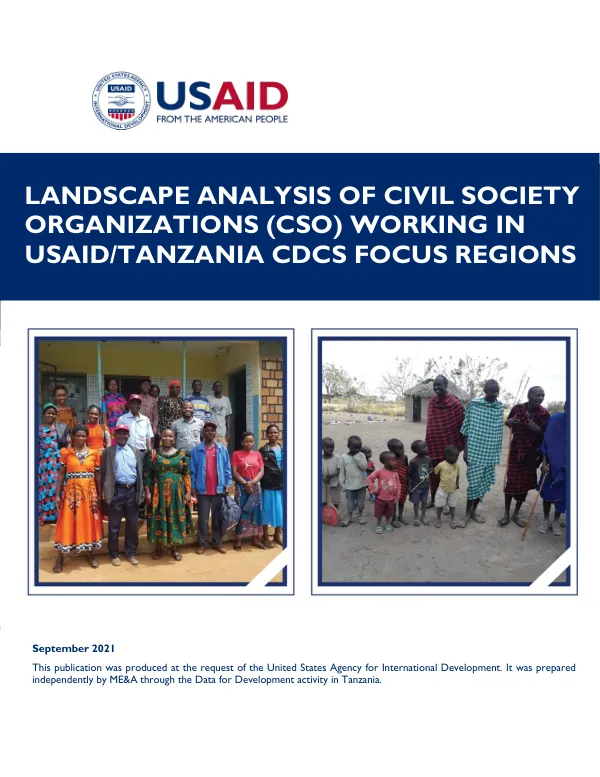
Landscape Analysis of Civil Society Organizations (CSO) Working in USAID/Tanzania CDCS Focus Regions
Sign inME&A, INC.
Landscape Analysis of Civil Society Organizations (CSO) Working in USAID/Tanzania CDCS Focus Regions
The landscape analysis of civil society organizations (CSOs) working in USAID/Tanzania CDCS focus regions was conducted in September 2021.
2021 · 156 pages
Sign in to readA free account is required to download.
Abstract
The study aimed to assess the types and locations of CSO activities in the CDCS focus regions, USAID sub-sectors, and activity scale and scope. The analysis also examined CSO networks, linkages, and partnerships, as well as institutional capacity assessment of CSOs. The study employed a mixed-methods approach, combining key informant interviews and survey data collection. A total of 644 CSOs participated in the survey, representing a diverse range of organizations working in various sectors, including economic growth, education, health, and disaster risk management. The survey data revealed that CSOs are engaged in a wide range of activities across the CDCS regions, with a focus on economic growth, education, and health. The analysis of CSO activities showed that the majority of CSOs are registered to work in the regions of Dar es Salaam, Dodoma, and Morogoro. The CSOs' office locations and geographical areas where they are registered to work are also presented in the study. The study further examined the national classification of CSOs, operational experience, size, and budgetary operations. The study also assessed the organizational capacity of CSOs using the Organizational Capacity Assessment (OCA) tool. The OCA tool evaluated CSOs' capacity in four domains: leadership and governance, management and operations, program management, and partnerships and resource mobilization. The study found that CSOs' organizational capacity levels vary across the regions, with some CSOs demonstrating high levels of capacity and others requiring support to improve their capacity. The study concluded that CSOs play a critical role in the development of Tanzania, particularly in the CDCS focus regions. However, the study also identified several challenges facing CSOs, including limited resources, inadequate capacity, and lack of coordination among CSOs. The study recommended that USAID increase the number of potential CSO partners, identify CSOs' capacity needs gaps, and continue USAID support for capacity-building activities. The study's findings have implications for USAID's development programs in Tanzania, highlighting the need for more effective partnerships with CSOs and support for their capacity development. The study's recommendations provide a framework for USAID to strengthen its partnerships with CSOs and improve the effectiveness of its development programs in Tanzania. The study's methodology involved a combination of key informant interviews and survey data collection. The survey data were collected using a structured questionnaire, which was administered to 644 CSOs. The study also used secondary data sources, including reports and documents from CSOs and other stakeholders. The study's findings are presented in a series of tables and figures, which provide a detailed analysis of CSO activities, organizational capacity, and other key indicators. The study's conclusions and recommendations are based on the analysis of the data and are intended to inform USAID's development programs in Tanzania. The study's results have implications for the development of Tanzania, highlighting the critical role that CSOs play in the country's development. The study's findings also underscore the need for more effective partnerships between CSOs and USAID, as well as support for CSOs' capacity development. The study's methodology and findings provide a framework for future research on CSOs in Tanzania, highlighting the importance of assessing CSOs' organizational capacity and identifying areas for support. The study's recommendations provide a roadmap for USAID to strengthen its partnerships with CSOs and improve the effectiveness of its development programs in Tanzania. The study's results are presented in a clear and concise manner, making it accessible to a wide range of stakeholders, including policymakers, development practitioners, and researchers. The study's findings and recommendations provide a valuable contribution to the literature on CSOs in Tanzania, highlighting the critical role that CSOs play in the country's development.
Related documents