ACADEMY FOR EDUCATIONAL DEVELOPMENT, INC. (AED)
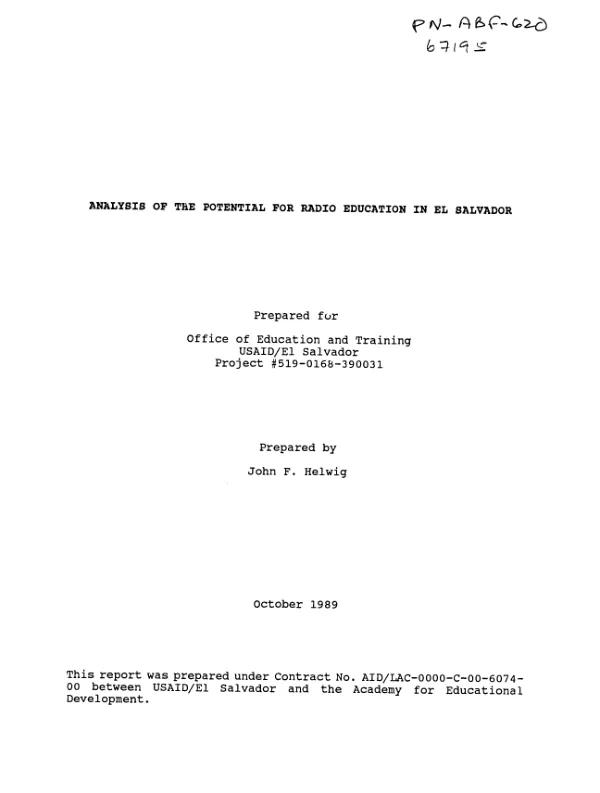
Analysis of the potential for radio education in El Salvador
The potential for radio education in El Salvador is analyzed in this report.
Helwig, John F. · 1989
Sign in to readA free account is required to download.
Abstract
To provide a proper perspective, the roles that television, distance education, and cultural promotion have played in formal and nonformal education are also examined. As in most developing countries, the number of radio listeners is very high. Survey results available from urban areas reveal that 96% of the respondents own radios. Experts believe that most rural homes have radios, and that while urban dwellers listen mostly to music programs, the rural population regularly listens to informational, religious, and news programs. The only consistently programmed educational broadcasting is found on YSAX, the station operated by the Archdiocese of San Salvador. This half-hour program, broadcast three times daily, supports an adult literacy program that currently involves about 30,000 participants in greater San Salvador and the surrounding populous rural areas. Much of the infrastructure necessary for a future radio education project already exists but is widely scattered among different Ministry of Education (MOE) divisions and departments. There are no clear definitions of terms such as "nonformal," "adult," and "distance" education, or "cultural promotion". The MOE is currently attempting to consolidate divisions, define an organizational structure, and delineate policies. The MOE should integrate the activities of distance education, adult education, and cultural promotion. In addition, the Department of Educational Television should be renamed "Department of Cultural and Educational Radio and Television," and should then prepare a written media policy, and reinforce its audio production and recording facilities and staff. Further recommendations for the MOE are included, along with suggestions for USAID/ES support. (Author abstract)