ACADEMY FOR EDUCATIONAL DEVELOPMENT, INC. (AED)
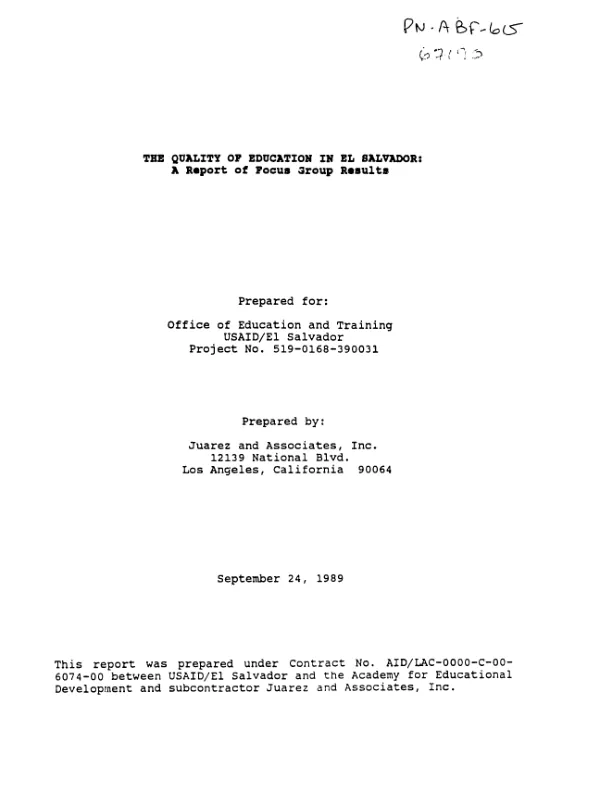
Quality of education in El Salvador : a report of focus group results
During August 1989, a series of focus group discussions were conducted with teachers, parents, and school administrators to gain firsthand perceptions of the quality of basic education (grades 1-6) in El Salvador.
Chavez, Rogelio Alfredo; Herrera, Enrique · 1989
Sign in to readA free account is required to download.
Abstract
This report presents the findings of the focus group study. (1) School staff view education as the means to develop a student"s ability to think critically. Parents, on the other hand, perceive education as a means for their children to acquire basic skills such as reading, writing, and knowledge of arithmetic. (2) Participants were aware that the content of the program for these grade levels consisted of instruction in the national language, the social and natural sciences, and lessons in reading, writing, and arithmetic. They also felt that the curricular program was a foreign product and failed to consider the needs of the children of El Salvador. Teacher preparation was viewed as weak, especially for newer ones. The lack of adequate teacher preparation through pre-service training was partially due to the dismantling of the Escuela Normal system. The absence of such a system contributed to the loss of the sense of professionalism as well as the mistica among new teachers. It was also felt that the MOE has failed in its responsibilities by not providing frequent inservice training which was badly needed to keep current on new pedagogical techniques as well as new views on child development. Parents are viewed as an important part of the educational process. Activities for their involvement, however, are limited to those outside the classroom, including payment of fees, maintenance of schools, or reviewing of homework. Education in El Salvador was characterized as deficient. Reasons include: (1) teacher-related factors (poor teacher preparation, inability to use the curricular program); (2) systemic factors (lack of such materials as texts, desks, and inadequate school facilities); (3) poor planning and organization, especially vis- a-vis the assignment of teaching posts; (4) poor programs such as the Promocion Orientada, which reduced children"s motivation to learn; and (5) parent-related factors (lack of financial resources, poor attitudes toward education). Although some viewed the system as disastrous, most persons pointed out that there was a base from which to work. This includes a number of able teachers, the availability of schools, and the existence of a curriculum. Participants viewed good teachers as those who: were involved in the classroom; motivated their children to learn and achieve; set and accomplished goals; worked as planners; and were concientizados of the needs of their students. Retention of students in a grade was primarily due to the student"s failure to master the skills for that level. Overall, the value of school was seen as a vehicle for advancement and not as a child care facility. Participants were very skeptical about the utility and functioning of educational programming through broadcast media. Most indicated that, at least for television, it already had been attempted and had failed. Its failure was due to the lack of proper training for those who implemented the program, the lack of attention given to the equipment, and to the idea that television is an entertainment medium not likely to be seen as a vehicle for education. Finally, it was mentioned that education is an interactive process, and media programming should incorporate such an aspect in its format. The principal reason cited for children not enrolling in school was that the parents could not afford to send them. The high costs of schooling (estimated at C. 200-700 per year per child) or the need for children to contribute financially to the family prevented them from continuing in school. Some participants, however, also alluded to the irresponsibility of parents who saw no value in educating their children. Finally, an average staff salary of C. 1200.00 was considered low by the participants in this study. Low salaries force teachers to seek supplementary employment which, in turn, affects their performance in the classroom. (Author abstract)
Related documents