USAID DEC
Analysis of the Supply in the Entrepreneurial Ecosystem in Mexico
The analysis of the supply in the entrepreneurial ecosystem in Mexico was conducted to identify the types of products and services offered to entrepreneurs, as well as the characteristics of the suppliers.
2015 · 29 pages
Sign in to readA free account is required to download.
Abstract
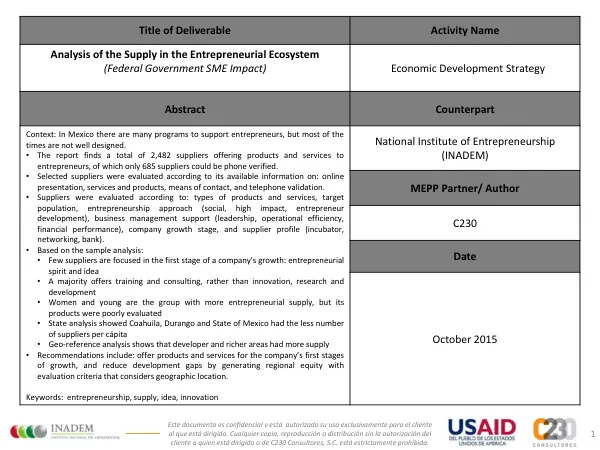
The study found a total of 2,482 suppliers offering products and services to entrepreneurs, of which only 685 suppliers could be phone verified. The suppliers were evaluated according to various criteria, including their online presentation, services and products, means of contact, and telephone validation. The evaluation was based on a set of indicators that assessed the suppliers' presentation online, means of contact, products and services, and contact and verification by telephone. Each indicator was scored on a scale of 0 to 1, with 1 being the highest score. The results of the evaluation showed that the majority of suppliers (61%) completed the online survey, while 23% responded partially. The survey revealed that 98% of the suppliers who responded were interested in appearing on the INADEM website. The study also found that there was a high level of "no response" to telephone calls, with an average of 3.4 calls made to each supplier before contact was established. The analysis of the suppliers' characteristics showed that few suppliers were focused on the first stage of a company's growth, which is the entrepreneurial spirit and idea. A majority of suppliers offered training and consulting services, rather than innovation, research and development. Women and young people were the groups with the most entrepreneurial supply, but their products were poorly evaluated. The study also found that the state with the least number of suppliers per capita was Coahuila, Durango, and the State of Mexico. The geo-reference analysis showed that developer and richer areas had more supply. The study recommended that products and services be offered for the company's first stages of growth, and that development gaps be reduced by generating regional equity with evaluation criteria that considers geographic location. The analysis of the suppliers' products and services showed that the majority of suppliers offered training and consulting services, while few offered innovation, research and development services. The suppliers' products and services were evaluated based on their relevance to the entrepreneurial ecosystem, and the study found that few suppliers offered products and services that were relevant to the ecosystem. The study also found that the suppliers' products and services were not well-suited to the needs of entrepreneurs in rural areas, and that there was a lack of suppliers offering products and services that were relevant to the needs of entrepreneurs in these areas. The study recommended that suppliers be encouraged to offer products and services that are relevant to the needs of entrepreneurs in rural areas. The study's findings have implications for policymakers and entrepreneurs in Mexico. The study's recommendations suggest that policymakers should prioritize the development of products and services that are relevant to the needs of entrepreneurs in rural areas, and that entrepreneurs should be encouraged to offer products and services that are relevant to the needs of entrepreneurs in these areas.