USAID DEC
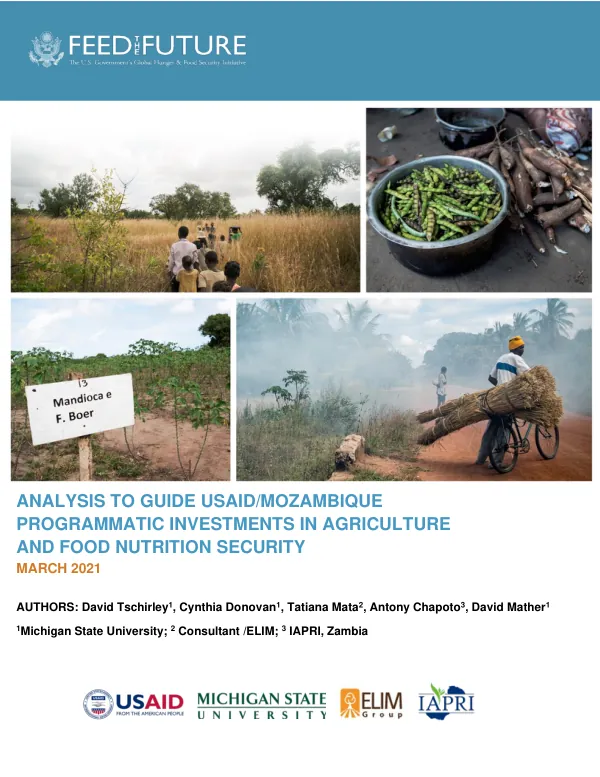
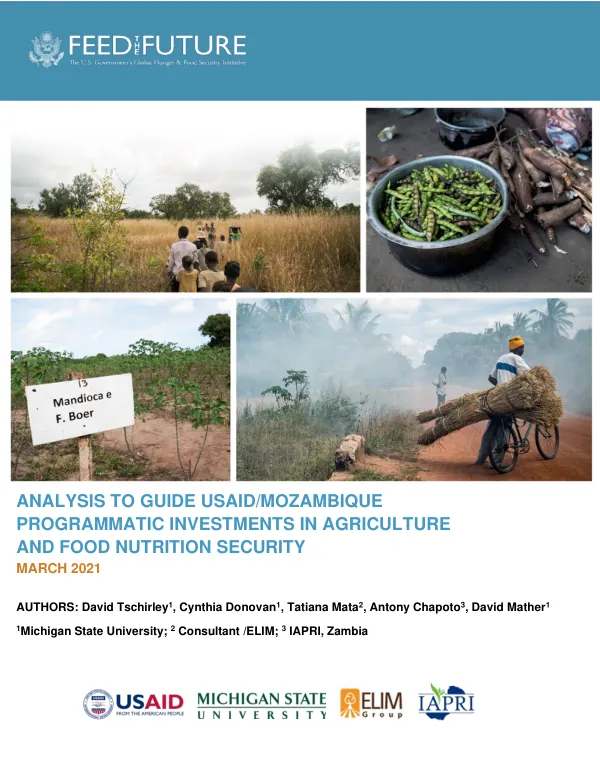
Analysis to Guide USAID/Mozambique Programmatic Investments in Agriculture and Food Nutrition Security
Sign inCORNELL UNIVARSITY INTERNATIONAL
Analysis to Guide USAID/Mozambique Programmatic Investments in Agriculture and Food Nutrition Security
The agricultural development initiative in Mozambique began with a comprehensive analysis to guide USAID's programmatic investments in agriculture and food nutrition security.
2021 · 74 pages
Sign in to readA free account is required to download.
Abstract
The report, prepared by the Feed the Future Innovation Lab for Food Security Policy, Research, Capacity, and Influence (PRCI), was funded by the United States Agency for International Development (USAID) under Grant No. 7200AA19LE00001. The report's authors conducted an online survey of key informants, key informant interviews in Mozambique, a regional review of programs, and a literature review to gather data and insights. They also consulted household data, defined zones and rural household types, and identified major global, continental, and national challenges affecting Mozambique's agricultural sector. Mozambique's rural areas face significant challenges, including very slow progress on the farm and limited opportunities for growth and transformation. However, emerging success stories not evident in the IAI data suggest that there are promising opportunities for agricultural development in the country. The report proposes a programmatic approach to address these challenges, which includes insights from program reviews in Mozambique and the region, a theory of change for rural transformation, and targeting of support to farming. The authors identify four broad categories of investment options: governance and the supply side of seed and other input markets, direct support to rural households, support to agricultural processing, and support for women and youth. The report highlights the importance of addressing the supply side of seed and other input markets, which is critical for improving agricultural productivity and competitiveness. It also emphasizes the need for direct support to rural households, particularly smallholder farmers, to improve their livelihoods, incomes, and food security. The authors identify several key findings, including the fact that rural household "transformation space" is characterized by a range of household types, from small-scale to large-scale farmers. They also note that per capita final consumer expenditure in Sub-Saharan Africa, including Mozambique, has been increasing over the past few decades, creating opportunities for growth and transformation in the agricultural sector. The report concludes by emphasizing the need for a programmatic approach that addresses the complex challenges facing Mozambique's agricultural sector. It highlights the importance of targeting support to farming, improving governance and the supply side of seed and other input markets, and providing direct support to rural households to improve their livelihoods, incomes, and food security. The authors also identify several key recommendations, including the need for USAID to design investments that promote rural structural transformation, support the development of agricultural processing, and address the needs of women and youth in the agricultural sector. They also recommend that USAID work with the Government of Mozambique to improve governance and the supply side of seed and other input markets. Overall, the report provides a comprehensive analysis of the challenges facing Mozambique's agricultural sector and proposes a programmatic approach to address these challenges. It highlights the importance of targeting support to farming, improving governance and the supply side of seed and other input markets, and providing direct support to rural households to improve their livelihoods, incomes, and food security.
Related documents
![NAPAS:Malawi Annual Work Plan [FY2016]](https://covers.devme.ai/gen/145459.webp)