JOHNS HOPKINS UNIVERSITY
Feed the Future Innovation Lab for Nutrition’s Global and Local Partners
The Feed the Future Innovation Lab for Nutrition conducts research to address questions related to agriculture and nutrition.
2021 · 68 pages
Sign in to readA free account is required to download.
Abstract
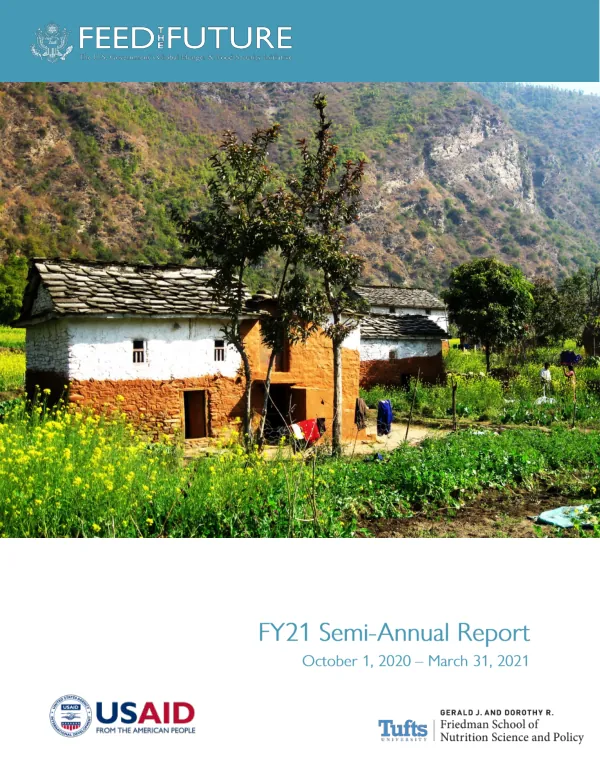
The lab's primary objectives are to understand the pathways through which agriculture can be leveraged to achieve improved nutrition, integrate multiple sectors of policy and program activity to improve maternal and child nutrition, and investigate the role of neglected biological mechanisms in nutrition. Empirical Evidence on Agriculture and Nutrition is being collected through the Policy and Science for Health Agriculture and Nutrition (PoSHAN) Community Studies in Nepal. This large dataset consists of over 40,000 person-visits conducted during four annual, nationally representative surveys from 2013 to 2016. The surveys were designed, led, and overseen by the Johns Hopkins University team through collaborative NGOs in Nepal across the mountains, hills, and plains of the country. The PoSHAN Community Studies were conducted in 21 districts in Nepal, including Taplejung, Terhathum, Morang, Solukhumbhu, Saptari, Ramechhap, Dhanusha, Sarlahi, Bara, Sindhupalchowk, Rasuwa, Kathmandu, Lamjung, Nawalparasi, Arghakhachi, Rolpa, Banke, Jumla, Mugu, Bajhang, and Doti. The study involved collaboration with Johns Hopkins University, National Agriculture Research Centre, Tribhuvan University, New Era, Nepali Technical Assistance Group, Institute of Medicine, Purdue University, and Tufts University. During this period, the JHU/Nutrition Innovation Lab team published three papers, had one paper in press, and four papers in submission. Team members also made seven presentations over the past six months related to the research. The presentations and publications focused on topics such as assessing predictors and metrics of diet quality, the intersection of agriculture, nutrition, and health, and the role of diet in early child development. Research has shown that factors associated with dietary diversity among pregnant women in the western hill region of Nepal include access to healthcare, education, and income. A review of the evidence on loss and waste in fish value chains found that nutritional loss is a significant issue in low- and middle-income countries. The study highlights the need for more research on the impact of loss and waste on food security and nutrition. The Feed the Future Innovation Lab for Nutrition is working to integrate multiple sectors of policy and program activity to improve maternal and child nutrition. This includes research on the role of neglected biological mechanisms in nutrition, such as aflatoxins and environmental enteric dysfunction. The lab is also working to develop and implement effective interventions to improve nutrition outcomes in low- and middle-income countries. The lab's research is being conducted in collaboration with various partners, including Johns Hopkins University, National Agriculture Research Centre, Tribhuvan University, New Era, Nepali Technical Assistance Group, Institute of Medicine, Purdue University, and Tufts University. The research is being conducted in several countries, including Nepal, Uganda, and Mozambique. The Feed the Future Innovation Lab for Nutrition is committed to improving nutrition outcomes in low- and middle-income countries. The lab's research is focused on understanding the pathways through which agriculture can be leveraged to achieve improved nutrition, integrating multiple sectors of policy and program activity to improve maternal and child nutrition, and investigating the role of neglected biological mechanisms in nutrition.