USAID DEC
Analyzing Transitional and Strategic Corruption and Kleptocracy in the Middle East and North Africa
Sign inTHE CLOUDBURST GROUP
Analyzing Transitional and Strategic Corruption and Kleptocracy in the Middle East and North Africa
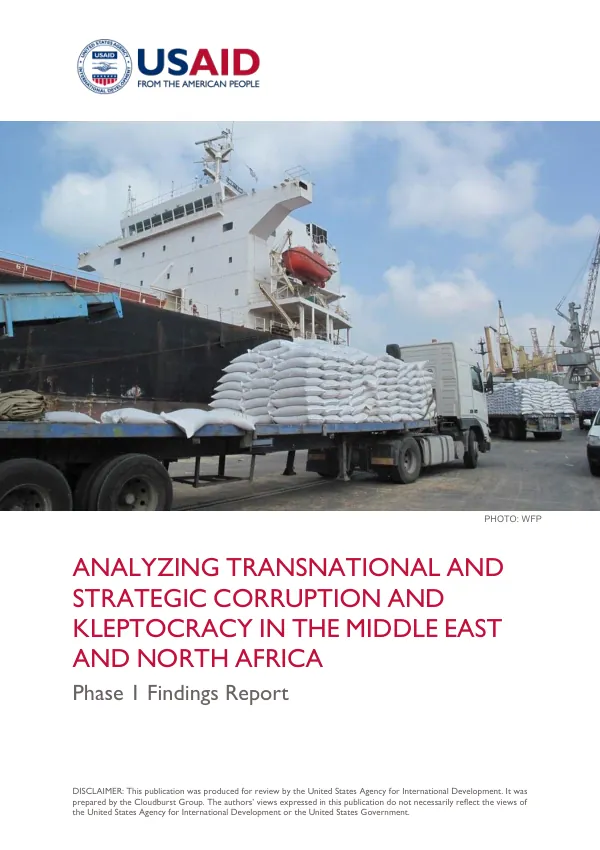
The Middle East and North Africa (MENA) region is characterized by thriving corruption and transnational corruption, which are deeply ingrained in the region's political economy.
2024 · 45 pages
Sign in to readA free account is required to download.
Abstract
These forms of corruption are embedded in networks connecting and blurring the boundaries between political leaders, senior public servants, business elites, violent political actors, criminal organizations, and foreign facilitators and enablers. As a result, corruption has become endemic to the extent that it defines governance throughout the region. The region's variations in political economies are a key factor in the sources, manifestation, and intensity of corruption. Despite virtually no country in MENA escaping high levels of corruption, its forms, levels, and varieties differ significantly. To capture these variations, five main pathways to stateness have been identified, which are not mutually exclusive. These pathways are detailed below and are visualized in Figure 1, along with an overview of the main features of each pathway and the forms of corruption associated with them in Table 1. The first pathway is the Fierce State (FSP), characterized by authoritarian, centralized statism and a turn to economic liberalization. This pathway is associated with manifestations of corruption, including grand corruption, embezzlement, and crony capitalism. The FSP is exemplified by countries such as Egypt, where corruption is deeply entrenched in the state apparatus. The second pathway is the Rentier State (RSP), marked by a reliance on oil and gas exports and a lack of economic diversification. This pathway is associated with manifestations of corruption, including corruption in the energy sector, embezzlement, and crony capitalism. The RSP is exemplified by countries such as Saudi Arabia and Qatar, where corruption is deeply ingrained in the state apparatus. The third pathway is the Liberal Democracy (LDP), characterized by a commitment to democratic principles and a market-based economy. This pathway is associated with manifestations of corruption, including petty corruption, petty corruption, and crony capitalism. The LDP is exemplified by countries such as Tunisia, where corruption is a significant challenge to democratic consolidation. The fourth pathway is the State Fragility (SFP), marked by a lack of state capacity and a reliance on external support. This pathway is associated with manifestations of corruption, including corruption in the security sector, embezzlement, and crony capitalism. The SFP is exemplified by countries such as Libya and Yemen, where corruption is a significant challenge to state stability. The fifth pathway is the Kleptocratic State (KSP), characterized by a government controlled by corrupt officials who use political power to enrich themselves. This pathway is associated with manifestations of corruption, including grand corruption, embezzlement, and crony capitalism. The KSP is exemplified by countries such as Syria and Iraq, where corruption is a significant challenge to state stability. These pathways are not mutually exclusive, and some countries may combine two or more pathways. For example, Iraq is a country that combines the FSP and KSP pathways, with a highly centralized state apparatus and a government controlled by corrupt officials. Similarly, Tunisia is a country that has shifted from the KSP to the LDP pathway, with a democratic transition initiated in 2011. The forms of corruption in MENA are diverse and complex, and they vary significantly across countries and sectors. However, they all share a common thread: the exploitation of power and resources for personal gain. This exploitation is facilitated by the region's weak institutions, lack of transparency, and limited accountability. As a result, corruption has become a significant challenge to governance, development, and human rights in the MENA region. The impacts of transnational corruption in MENA are far-reaching and devastating. They include the diversion of public resources, the undermining of state capacity, and the perpetuation of poverty and inequality. Transnational corruption also has a significant impact on the region's economic development, with estimates suggesting that corruption costs the region billions of dollars annually.
Related documents