ADVANCED ENGINEERING ASSOCIATES INTERNATIONAL, INC. /SGGA
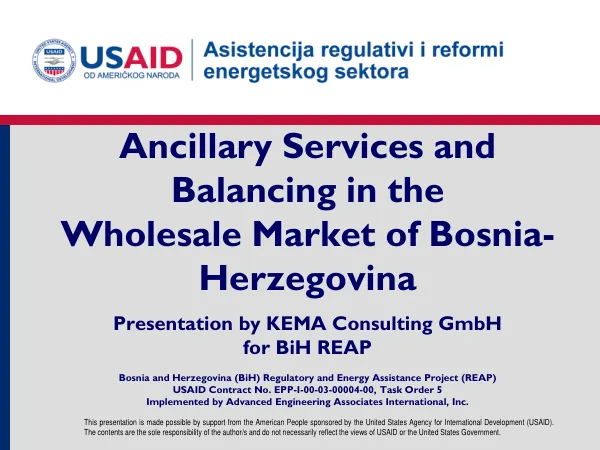
Ancillary Services and Balancing in the Wholesale Market of Bosnia-Herzegovina
Ancillary Services and Balancing in the Wholesale Market of Bosnia and Herzegovina is a critical component of the country's energy infrastructure.
2014 · 19 pages
Sign in to readA free account is required to download.
Abstract
The current arrangements for ancillary services and balancing in the wholesale market are characterized by several key issues. Non-provision of reserves due to the absence of market value-oriented remuneration and ineffective or absent penalty schemes is a major concern. Additionally, there is no means for downward regulation beyond secondary control, and lack of meter values for settlement of EP's imbalances is a significant issue. Other relevant issues include sub-optimal allocation of ancillary services obligations to EPs and unnecessarily high burden on consumers. Issues that are out of scope include water management for Caplina and supply tariff regulation at entity level. To address these challenges, essential requirements for a future framework include ensuring that ISO has access to sufficient volumes of ancillary services at all times, providing incentives to provide ancillary services, penalizing non-availability or non-delivery, and incentivizing reduction of imbalances. Additional objectives for the future framework include facilitating optimal allocation of ancillary services obligations, expanding the range of balancing services to increase operational flexibility, and limiting costs to consumers. Areas to be considered in the development of a new framework include procurement of reserves, real-time balancing, metering and imbalance settlement, and financial settlement. Procurement of reserves is a critical component of the wholesale market, and three options are being considered: regulated procurement with increased penalties, regulated obligations with a daily adjustment mechanism, and tenders for ancillary services. Regulated procurement with increased penalties (Option 1) has several advantages, including similarity to the current status quo and limited need for change. However, it also has several drawbacks, including risk of insufficient incentives, remuneration that does not reflect opportunity costs, and penalties that are returned to EPs. Regulated obligations with a daily adjustment mechanism (Option 2) has several advantages, including benefits of the secondary market and incentives for EPs to provide contracted and additional volumes. However, it also has several drawbacks, including initial distribution of reserve obligations and potential exposure to risk of excessive prices. Tenders for ancillary services (Option 3) has several advantages, including market-based allocation and remuneration of reserve obligations and creation of strong incentives for EPs to offer and provide contracted volumes. However, it also has several drawbacks, including potential for substantially higher costs for consumers and difficulty in estimating the cost of ancillary services in advance. Real-time balancing is also a critical component of the wholesale market, and several options are being considered, including transition to market-based pricing of balancing energy, introduction of a daily balancing market for contracted reserves and additional volumes, and consideration of mandatory bidding.