USAID DEC
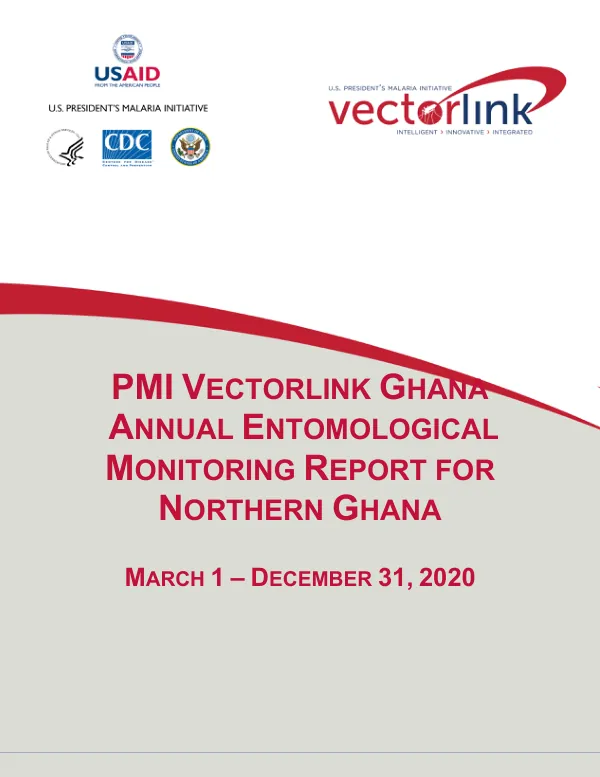
Annual Entomological Monitoring Report for Northern Ghana, March 1-December 31, 2020
Sign inABT ASSOCIATES
Annual Entomological Monitoring Report for Northern Ghana, March 1-December 31, 2020
The PMI VectorLink Ghana project conducted entomological monitoring in Northern Ghana from March 1 to December 31, 2020.
2021 · 49 pages
Sign in to readA free account is required to download.
Abstract
The project aimed to assess the effectiveness of indoor residual spraying (IRS) in reducing malaria transmission. The monitoring sites were located in 15 districts, with a total of 30 sentinel sites. The vector species composition in the study area was dominated by Anopheles gambiae s.l., which accounted for approximately 90% of the total Anopheles species collected. The human biting rate (HBR) of An. gambiae s.l. was significantly higher in unsprayed sites compared to sprayed sites, with a mean indoor HBR of 0.45 bites per person per night in unsprayed sites and 0.15 bites per person per night in sprayed sites. The parity rate of An. gambiae s.l. was also higher in unsprayed sites, with 55% of females being parous compared to 35% in sprayed sites. The blood meal source analysis revealed that An. gambiae s.l. fed on humans in both sprayed and unsprayed sites, with a higher proportion of females feeding on humans in unsprayed sites. The Plasmodium falciparum sporozoite rate was significantly higher in unsprayed sites, with 12.5% of An. gambiae s.l. females infected with P. falciparum sporozoites compared to 5.5% in sprayed sites. The entomological inoculation rate (EIR) was estimated to be 0.25 infectious bites per person per year in unsprayed sites and 0.10 infectious bites per person per year in sprayed sites. The spray quality and residual efficacy of Actellic 300CS and SumiShield 50WG were evaluated using cone bioassays, which showed that both insecticides had good residual efficacy on cement, mud, and wood surfaces. The results of the insecticide susceptibility tests showed that An. gambiae s.l. was susceptible to the tested insecticides, with a mortality rate of 90% or higher in all tests. However, the resistance intensity assays revealed that An. gambiae s.l. had developed resistance to pyrethroids, with a resistance intensity of 2.5 or higher in all districts. The synergist assays showed that the combination of piperonyl butoxide (PBO) and permethrin (PER) had a synergistic effect on An. gambiae s.l., with a mortality rate of 95% or higher in all tests. The molecular analyses revealed that the Ace-1 and kdr alleles were present in An. gambiae s.l. populations, with a higher frequency of the Ace-1 allele in sprayed sites. The overall results of the entomological monitoring report suggest that IRS is an effective tool for reducing malaria transmission in Northern Ghana. The project's findings will inform the development of evidence-based malaria control strategies in the region.
Related documents