USAID DEC
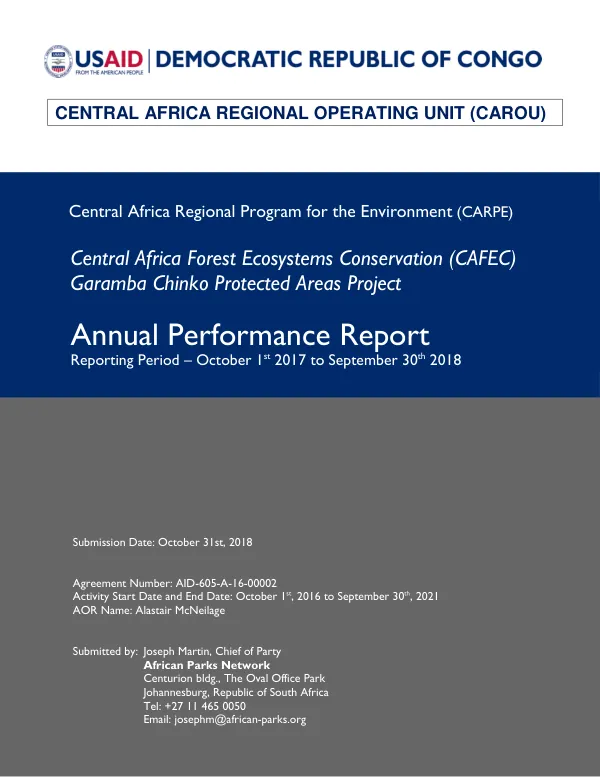
Annual Performance Report: Central Africa Forest Ecosystems Conservation (CAFEC) Garamba Chinko Protected Areas Project
Sign inCATHOLIC RELIEF SERVICES ORGANIZATION
Annual Performance Report: Central Africa Forest Ecosystems Conservation (CAFEC) Garamba Chinko Protected Areas Project
The Central Africa Forest Ecosystems Conservation (CAFEC) project, also known as the Garamba-Chinko Protected Areas project, is a conservation initiative aimed at strengthening capacity for biodiversity conservation planning and implementation in the Democratic Republic of Congo and the Central African Republic.
2018 · 54 pages
Sign in to readA free account is required to download.
Abstract
The project is part of the Central Africa Regional Program for the Environment (CARPE) and is implemented by the African Parks Network. The project's primary goal is to achieve a higher standard of park management and reduce threats to wildlife in Garamba National Park and the Chinko Project Area by 2021. To achieve this, three key sub-purposes are being pursued: improving the security of the protected areas, strengthening management capacity, and developing partnerships and consistency for conservation. Significant progress was made in Year 2, despite operational difficulties caused by insecurity in eastern CAR. In the Chinko Project Area, a core area of 3,000 km2 was secured during the 2017-2018 dry season, and no known poaching incidents occurred in that area. Additionally, more than 13,500 km2 was kept free from cattle herders due to efficient Law Enforcement, including ground patrols and aerial surveillance. The annual wildlife survey conducted in 2018 showed a clear increase in wildlife numbers, particularly predators, buffaloes, and antelopes. The Chinko Project Area currently has 50 well-equipped rangers and 4 Control Room Operators who have been trained to the level of Ranger. However, recruitment of new rangers was postponed to 2019 due to the current security situation. Herder sensitization was conducted during the dry season, and the strategy proved successful in keeping a total area of 17,603 km2 free from entry of cattle herders. In Garamba National Park, the revised Law Enforcement Strategy implemented in 2016 has greatly increased the capability and capacity of the ranger force. The systematic and tailored training has translated to less poaching of key species within the Garamba Complex. During Year 2, GNP conducted the third Basic Field Ranger course, which resulted in 50 new recruits joining the Park's ranger force. The ranger force now consists of 238 Rangers and 51 Security Guards, representing a 30% increase in numbers since August 2016. As a result of the professionalization of the ranger force, poaching in the Garamba Complex has significantly decreased. In 2016, 91 elephants were poached; in 2017, 50 elephants; and in 2018, only three elephants were found with signs of poaching, reducing elephant poaching by 45% in the first year and 98% in the second year. The increased numbers and capacity of the ranger force have also led to a decrease in poaching of other key species. The project has also made progress in community development initiatives, including the creation of pastoralism corridors and the implementation of a transhumance strategy. However, these projects are dependent on the return of security in the communities, many of which remain inaccessible to this day. The project will continue to implement planned activities, but some delays may occur due to the regional state of insecurity. The project has received support from various organizations, including USAID, the U.S. Department of State, and the EU, which has enabled the purchase of vital equipment and rations. The project has also received international fundraising support to continue its operations. The project's management team has been strengthened, and administrative structures have been put in place to execute core activities efficiently.